
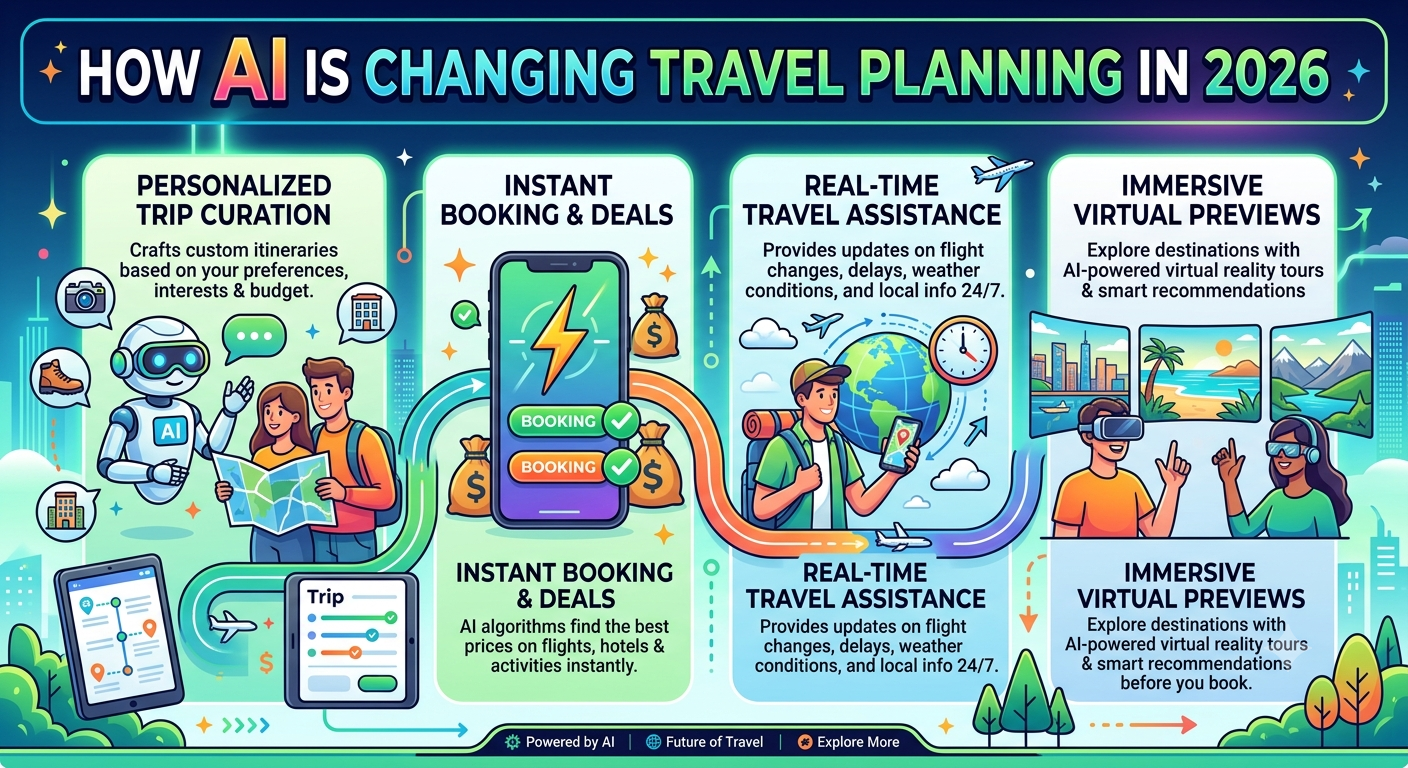
Travel planning used to mean dozens of open browser tabs, hours of comparing flight prices, and endless scrolling through reviews . In 2026, that entire process has been compressed into a few natural-language prompts.
Artificial intelligence has moved from feature on travel websites to becoming the operating system of modern trip planning. Handling research, personalization, price prediction, and increasingly, the booking itself.
This guide breaks down exactly how AI is reshaping travel planning in 2026. The types of tools driving this shift, the data behind traveler adoption, the benefits and limitations, and what’s coming next.
Whether you’re a traveler trying to plan smarter or a business trying to understand where the industry is headed, this is the complete picture.
The State of AI Travel Planning in 2026
AI adoption in travel has moved past the experimental phase. Survey data from early 2026 shows that roughly 90% of travelers are now aware that AI can help plan or book a trip. Though actual usage still trails awareness — a gap that reflects habit more than distrust. Among travelers who have already used AI for planning, reliance runs deep, and trust in AI recommendations is now on par with, or higher than, trust in traditional sources for a large share of users.
Separate research from McKinsey found that although less than a third of travelers have used generative AI for travel-related tasks so far around 84% . Reported that it improved their overall experience. Adoption is even more pronounced. In emerging markets like India and China, where over 90% of travelers say they’re willing to use AI tools for trip planning. A trend being driven largely by younger, digitally native demographics.
The most common AI use cases in 2026 aren’t just itinerary building. Travelers are using AI for travel inspiration, local food recommendations, transportation planning, budgeting, and even packing assistance . Inspiration and local discovery leading adoption ahead of full itinerary creation.
The Types of AI Tools Changing Travel Planning
AI’s impact on travel isn’t a single feature — it’s a stack of specialized tools, each solving a different part of the planning journey.
1. AI Itinerary Generators
These tools take a simple prompt — “Plan a 4-day beach vacation on a mid-range budget” — and return a full day-by-day plan with flights, hotels, and activities within seconds.
Instead of generic templates, modern itinerary generators analyze user preferences, past travel history, and behavior patterns to build a tailored plan rather than a one-size-fits-all list of tourist spots.
2. Conversational, Chat-Based Travel Assistants
2026 has cemented the shift from search-based to conversational travel planning. Instead of typing keywords into a search bar, travelers now describe what they want in natural language — “a romantic European city trip in spring, medium budget” — and receive a structured plan with flights, hotels, and activities.
The more a traveler uses one of these assistants, the more it learns their preferences, refining future suggestions around things like preferred hotel type, direct flights, or cultural versus beach destinations.
3. AI-Powered Price Prediction and Deal Finders
AI systems now analyze market demand, seasonal patterns, and historical pricing data to predict when flight and hotel prices are likely to rise or fall. This lets travelers time their bookings more strategically instead of guessing, and it’s one of the clearest, most measurable ways AI is saving travelers money.
4. AI Chatbots for Customer Support
On the booking and post-purchase side, AI chatbots now handle the majority of routine customer service interactions — managing reservations, answering policy questions, and processing pre-check tasks without human intervention. This has freed up human agents to focus on complex, high-stakes situations that actually require empathy and judgment.
5. Agentic AI Travel Assistants
The newest and fastest-growing category is agentic AI — tools that don’t just recommend but act. In 2026, major AI platforms have integrated directly with booking ecosystems
: conversational assistants now connect to platforms like Booking.com, Expedia, Uber, and food delivery apps, allowing users to search for and select flights, hotels, and rides without leaving the chat interface.
Booking completion still typically happens on the partner site, but discovery and decision-making now happen almost entirely inside the AI layer.
Analysts expect the next phase — full end-to-end agentic booking, where AI compares inventory, holds reservations, and manages changes without manual input — to mature by 2027.
6. AI Inside Search Engines
Search itself has been rebuilt around AI. Google’s AI-powered Search features now let users build itineraries directly inside an interactive canvas, blending live data from Flights, Maps, and the open web to suggest hotels, restaurants, and activities matched to stated preferences.
Its AI-driven flight deal discovery tools have expanded to cover more than 200 countries and dozens of languages, letting travelers search conversationally for affordable destinations rather than fixed routes.
How AI Personalizes Every Stage of the Trip
AI’s influence isn’t limited to the planning stage — it now touches the entire travel lifecycle:
- Inspiration: AI analyzes reviews, social media signals, and travel trend data to surface destinations and experiences that go beyond the obvious tourist hotspots, matched to individual taste rather than popularity alone.
- Planning: Conversational tools turn vague ideas into complete, bookable itineraries in minutes rather than hours.
- Booking: Integrated AI-to-OTA connections let travelers move from idea to reservation with minimal friction, while price-prediction models help time purchases.
- During the trip: Real-time AI assistance can rebook disrupted flights, recommend nearby restaurants on the fly, monitor safety and travel conditions, and adjust plans dynamically based on weather or delays.
- Post-trip: Behavioral data from completed trips feeds back into the system, sharpening recommendations for the next journey.
Looking ahead, the next generation of these systems is expected to go further — anticipating disruptions like weather shifts or tourist congestion before they happen, and adjusting plans proactively rather than reactively.
Benefits of AI in Travel Planning
- Massive time savings: What once took hours of manual research and comparison now takes minutes.
- Deeper personalization: Recommendations are built around individual behavior and preference data, not generic popularity rankings.
- Smarter pricing: Predictive models help travelers catch better deals on flights and accommodation.
- Reduced booking errors: Automated systems minimize the manual mistakes common in multi-platform booking.
- 24/7 support: AI chatbots resolve routine issues instantly, without wait times.
- Discovery of hidden gems: By analyzing large, unstructured datasets, AI surfaces authentic, lesser-known experiences that traditional search often buries.
Challenges and Limitations of AI Travel Planning
AI travel planning isn’t without friction points, and being upfront about them matters for anyone relying on these tools:
- Accuracy varies with specificity. AI recommendations are strong for mainstream, high-data destinations but less reliable for niche or highly local details, where real-time changes (like a temporary closure) may not be reflected.
- Lack of firsthand judgment. AI can process data at scale, but it doesn’t have lived experience — it can’t sense whether a neighborhood “feels right” the way a well-traveled human advisor can.
- Verification is still necessary. Travel experts consistently recommend cross-checking AI-generated pricing, availability, and safety details against official sources before finalizing bookings.
- Prompt quality determines output quality. Generic prompts produce generic itineraries. Getting real value from AI travel tools requires specifying traveler profile, budget, interests, constraints, and timing — vague requests are still the biggest reason people say AI “didn’t understand what I wanted.”
The Role of Human Expertise Alongside AI
Despite rapid AI adoption, human travel advisors aren’t being replaced — their role is shifting. AI is excellent at handling the research-heavy, repetitive front end of travel planning: comparing options, generating ideas, and building draft itineraries at speed.
But turning those AI-generated possibilities into a reliable, real-world trip — handling disruptions, managing complex multi-destination logistics, and taking accountability when plans change — remains a distinctly human strength.
The winning model emerging in 2026 combines three layers: AI-assisted planning for speed and ideation, human expertise for curation and accountability, and reliable booking infrastructure to execute on what was promised.
For travel businesses and agencies, this is the practical takeaway — AI should accelerate the front end of the client journey, not replace the trust layer that keeps clients coming back.
What’s Next: Predictions Beyond 2026
The trajectory is clear even if the exact timeline isn’t fixed. Analysts expect a near-term shift toward fully agentic AI travel execution — systems that don’t just suggest but autonomously compare inventory, hold reservations, and coordinate changes without manual intervention, likely maturing around 2027.
Beyond that, expect predictive systems that anticipate climate disruptions, tourist congestion, and even shifts in traveler mood to adjust plans proactively, along with more immersive tools like AR-based trip previews before a traveler ever leaves home.
How Travel Brands Are Responding to the AI Shift
The rise of AI-driven discovery is also reshaping how travel brands get found. Adobe Analytics data cited in early 2026 industry reporting showed that traffic referred to travel retail sites from generative AI sources jumped over 1,000% year-on-year, and that visitors arriving from AI sources converted at a notably lower bounce rate than traditional search traffic.
For travel businesses, this has real strategic implications. Content and listings need to be structured so AI systems can parse and recommend them accurately. Clear pricing, up-to-date availability, structured data, and authentic review signals all matter more, not less, in an AI-mediated discovery environment.
Brands that treat AI visibility as an extension of their SEO and content strategy — rather than a separate. Optional channel — are the ones showing up inside AI-generated itineraries and chat recommendations today.
Frequently Asked Questions
Is AI travel planning accurate? AI recommendations are generally strong for mainstream destinations and common requests. These benefit from large amounts of training and real-time data.
Accuracy drops for niche, hyper-local, or fast-changing details, like pricing and availability with official sources is still recommended.
Will AI replace human travel agents? No. AI is automating the repetitive, data-heavy parts of travel planning — research, comparison, basic recommendations. Which frees human advisors to focus on judgment-heavy work: complex logistics, disruption management, and personalized. Service that requires empathy and real-world accountability.
What are the most popular AI use cases in travel right now? Travel inspiration and local food recommendations lead adoption, followed closely by transportation planning, full itinerary creation, and budgeting. Packing assistance is currently the least-used feature.
How do I get better results from AI travel planning tools? Be specific. Include your traveler profile, budget, travel dates, interests, and any constraints (dietary needs, mobility, group size). Iterative refinement — asking the AI to adjust pacing, swap activities, or add backup plans for weather . Consistently produces better itineraries than one-shot generic prompts.
What’s the difference between conversational AI and agentic AI in travel? Conversational AI tools generate recommendations and itineraries based on natural-language prompts, but a human still completes the booking. Agentic AI goes further, connecting directly to booking platforms to search, compare. In some cases initiate transactions — moving from an assistant role toward an execution role.
Conclusion
AI has fundamentally changed the mechanics of travel planning in 2026. Compressing hours of research into minutes, and beginning the shift from assistance toward full execution.
But the data is equally clear that the traveler experience is best. When AI and human expertise work together : AI accelerates discovery and ideation. While human judgment and accountability still close the gap between an AI-generated plan and a smooth, real-world trip.
For travelers and travel businesses alike, the opportunity in 2026 isn’t choosing between AI or human expertise. It’s building a planning process that uses both well.

Muhammad Safiullah is the AI Agent Development Lead at Rankify SEO & AI Agency, where he builds AI chat agents and automation systems for SaaS and business clients. His work focuses on practical AI implementation that solves real customer support and lead-generation challenges.