
Most agency owners use “white label SEO” and “SEO reseller” like they mean the same thing. They don’t. One model builds your brand. The other rents someone else’s.
Picking the wrong one costs more than money. It costs client trust, profit margin, and years of growth you can’t get back. This guide breaks down both models in plain terms, compares real numbers, and gives you a framework to decide which one fits your agency today.
Quick Answer: White Label SEO vs SEO Reseller
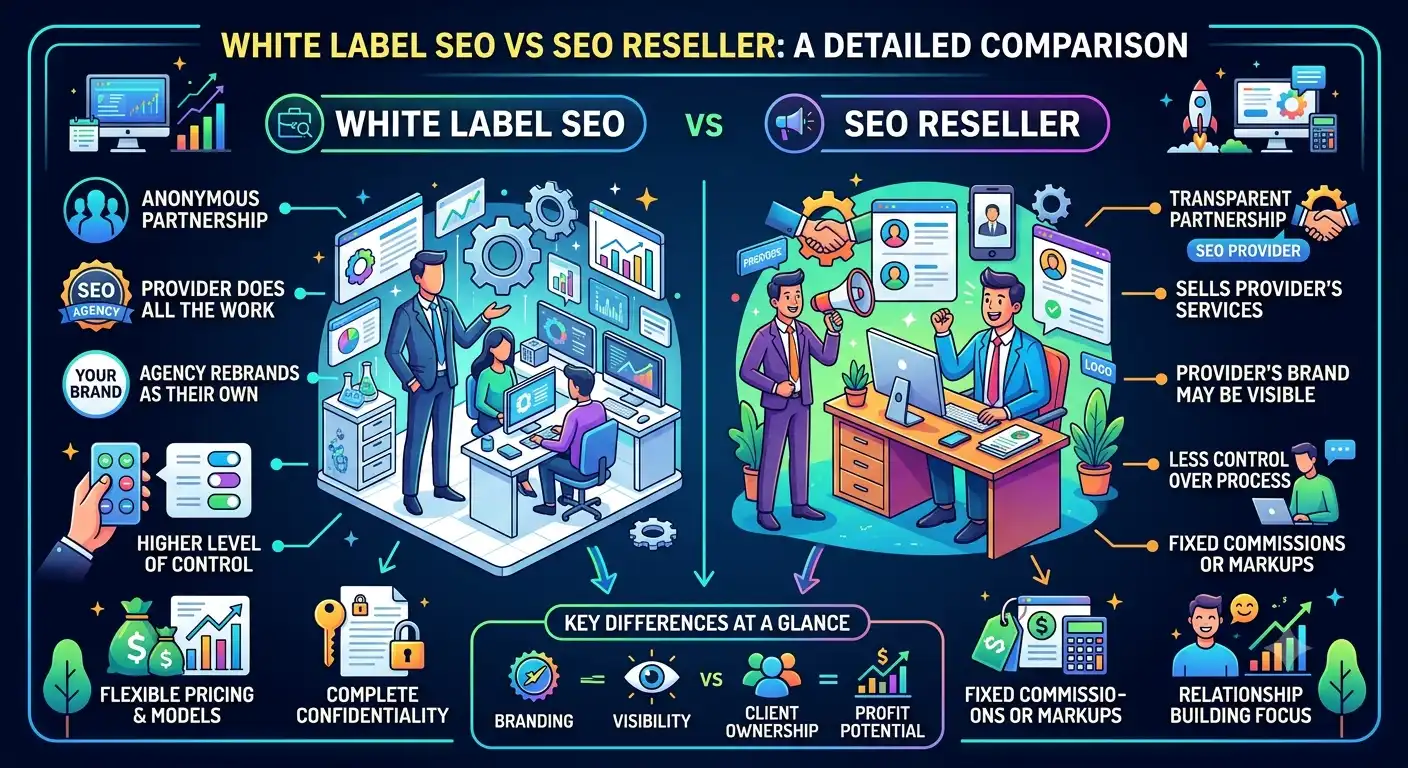
White label SEO means a fulfillment partner does the SEO work behind the scenes, but everything the client sees — strategy, reports, communication — carries your agency’s brand. You own the client relationship completely.
SEO reseller means you sell a provider’s pre-built SEO packages, often with limited customization. The provider’s brand, tools, or processes may surface to the client, and you have less control over delivery.
Short version: Choose white label SEO if you want control, higher margins, and long-term brand equity. Choose an SEO reseller program if you want a fast, low-effort add-on with minimal setup.
What Is White Label SEO?
White label SEO is an outsourcing model where a specialist agency performs the SEO work — audits, content, link building, technical fixes — while your agency stays the only name the client ever sees. The fulfillment partner stays invisible. Your agency handles sales, strategy calls, and client relationships.
Demand for this model keeps climbing. Global SEO spending is projected to grow from roughly $72.3 billion in 2025 to $106.15 billion by 2030, and SEO consistently produces a higher lead-to-close rate than most outbound channels. Agencies that can’t build an in-house team still need a way to capture that demand. White label SEO is how they do it.
How White Label SEO Works
You sign a client. Your fulfillment partner builds a custom strategy based on that client’s industry, goals, and competitors. Reports go out on your letterhead. Your account manager runs the calls. The client never learns a third party exists.
Who White Label SEO Is Built For
This model fits full-service digital marketing agencies that already run PPC, social, or web design and want SEO to slot in as a native offering. It also fits niche consultancies — PR firms, branding studios — that need SEO delivered at the same quality level as their core service, because their reputation depends on it.
What Is an SEO Reseller Program?
An SEO reseller program is a productized, wholesale arrangement. You buy fixed SEO packages — say, a “10-keyword plan” or a “20-backlink bundle” — from a provider, then resell them to clients with a markup. The strategy is standardized. Customization is limited or unavailable.
In some reseller setups, the provider’s branding, dashboard, or communication style still reaches the client. You act more like a distributor than a strategic partner.
How SEO Reseller Programs Work
You pick a package tier — basic, standard, premium — and sell it as-is. The provider executes according to their own SOP. Your involvement is usually limited to the initial sale and periodic check-ins.
Who SEO Reseller Programs Fit Best
Freelancers, solo consultants, and web design shops that get occasional SEO requests but don’t want to build a delivery process fit this model well. It’s also common for newer agencies validating whether SEO demand exists in their client base before investing further.
White Label SEO vs SEO Reseller: Key Differences at a Glance
| Factor | White Label SEO | SEO Reseller |
| Branding | 100% your agency’s brand | Provider’s brand may surface |
| Client relationship | You own it fully | Often shared or provider-influenced |
| Customization | Fully tailored strategy | Fixed, pre-packaged deliverables |
| Typical gross margin | 38–52% | 18–28% |
| Setup effort | Higher upfront | Minimal |
| Best for | Scaling agencies building brand equity | Freelancers and early-stage agencies |
| Client switching risk | Lower, relationship is yours | Higher, infrastructure belongs to provider |
Those margin figures come from Agency Analytics benchmark data and line up with what most operators report after running both models.
Branding and Client Relationship Ownership
Branding decides who the client trusts. It’s the single biggest fork between these two models.
White Label SEO Branding
Every touchpoint — proposals, dashboards, monthly reports, even the login portal in some setups — carries your agency’s name. The client sees one accountable partner: you. That perception builds retention, because clients rarely leave a relationship they believe is fully yours.
SEO Reseller Branding
Reseller programs vary. Some allow partial branding. Many still expose the provider’s tools, templates, or support team somewhere in the process. Once a client notices a third party, your positioning as the “expert” weakens, and so does their reason to stay loyal to you specifically.
Pricing, Margins, and Profitability Compared
Margin is where the two models diverge hardest, and it’s the number that should drive your decision more than any other factor.
Typical White Label SEO Margins
Agencies running white label SEO retainers typically report gross margins between 38% and 52%. You set retail pricing, the fulfillment partner charges wholesale, and the spread is yours. Margins improve further as you build repeatable processes and negotiate better wholesale rates at volume.
Typical SEO Reseller Margins
Reseller-model agencies average 18% to 28% gross margin. The ceiling is fixed by the provider’s wholesale rate. No matter how well you sell, you can’t push past that structural limit — which is why most agencies outgrow reseller programs within 12 to 18 months.
Types of White Label SEO Services
White label providers rarely offer just one service. A full-scope partner typically covers:
Core Deliverables
Technical SEO audits, on-page optimization, keyword research and mapping, content writing, and link building form the backbone of most white label engagements. These are the deliverables clients expect in any standard SEO retainer.
Advanced or Specialized Services
More mature white label partners also offer local SEO campaigns, e-commerce SEO, digital PR and outreach, Core Web Vitals and page speed fixes, and increasingly, AEO and GEO work — optimizing content so it gets pulled into AI Overviews and answer engines like ChatGPT or Perplexity, not just classic blue links.
Types of SEO Reseller Programs
Not all reseller programs work the same way.
Fixed-Package Resellers
These providers sell tiered bundles — basic, standard, premium — with set deliverables like a fixed number of blogs or backlinks per month. You mark up the price and sell it as-is, with little room to adjust scope per client.
Affiliate or Referral Resellers
Some reseller arrangements are closer to affiliate marketing. You simply refer a lead to the SEO company and earn a commission. You have almost no involvement in delivery, strategy, or client communication after the handoff.
Pros and Cons of White Label SEO
Advantages
You control pricing, branding, and strategy end to end. Margins run higher. Clients build loyalty to your agency specifically, not to a service they could buy elsewhere. It integrates cleanly alongside PPC, social, and content services you already sell.
Drawbacks
Setup takes more time. You’re responsible for vetting a quality fulfillment partner, since poor execution still damages your brand, not theirs. Onboarding, QA, and reporting workflows need to exist before you scale.
Pros and Cons of SEO Reseller Programs
Advantages
Setup is fast, often live within a week. Operational overhead stays low, which suits freelancers or agencies testing SEO demand before committing further.
Drawbacks
Margins cap out low. Customization is limited, so complex or high-value clients often get underserved. Because the infrastructure belongs to the provider, your client’s switching cost — leaving you — stays low too.
White Label SEO vs SEO Reseller vs In-House SEO Team
An in-house team gives you full control and no dependency on outside partners, but it’s the most expensive and slowest option to build — hiring, training, and tooling can take months before results even start. White label SEO delivers most of that control without the payroll or ramp-up time. A reseller program sacrifices control entirely in exchange for the fastest, cheapest setup. Most scaling agencies land on white label SEO as the middle path: near in-house control, without in-house cost.
How to Choose the Right Model for Your Agency
Run through these questions before deciding:
- Do you want full control over branding and client communication? If yes, white label SEO fits.
- Do your clients span multiple industries that need customized strategy? White label SEO handles that; fixed reseller packages usually don’t.
- Are you testing whether SEO demand exists in your current client base before investing further? A reseller program is the lower-risk starting point.
- Is long-term retention and lifetime client value your main growth metric? White label SEO protects that better, since you own the relationship.
- Do you need SEO live within days with almost no operational setup? Reseller programs win on speed.
Many agencies start with a reseller program to validate demand, then transition to white label SEO once volume justifies the higher-margin, higher-control model.
Google E-E-A-T Guidelines and Why They Matter Here
Google evaluates content and sites through Experience, Expertise, Authoritativeness, and Trustworthiness — E-E-A-T. This matters directly for white label and reseller SEO buyers, because the quality of the partner you choose determines whether your clients’ sites meet that bar or get flagged by it.
Cheap, AI-generated content with no editorial review, spun articles, or link placements from private blog networks all work against E-E-A-T. A reliable white label or reseller partner should use real writers, disclose sourcing standards, and avoid link schemes Google has explicitly warned against. If a provider won’t show you sample audits, reporting, or sourcing standards, treat that as a warning sign, not a minor gap.
Common Mistakes Agencies Make When Choosing a Partner
Many agencies pick based on price alone and skip vetting the provider’s actual work quality. Others assume “white label” automatically means high quality, when execution still varies widely between providers. A third common mistake: signing a reseller program without reading how client communication is actually handled, only to find the provider’s name showing up in a report or email months later.
A fourth mistake shows up later: locking into a long contract before running a trial account. A single test client, run for 60 to 90 days, tells you more about a partner’s real quality than any sales call.
How to Vet a White Label SEO or Reseller Partner
Before signing with any provider, run this checklist:
Delivery and Quality Checks
Ask for a sample technical audit and a sample piece of written content. Confirm whether writers are human, AI-assisted, or fully AI-generated — this directly affects your E-E-A-T standing with Google. Check their link-building sourcing: legitimate digital PR and outreach are fine, private blog networks and paid link farms are not.
Reporting and Communication Checks
Confirm reports can be fully white-labeled, including sender email addresses and dashboard URLs. Ask how fast they turn around client questions, since slow responses from a partner become your problem the moment a client is waiting.
Contract and Margin Checks
Get wholesale pricing in writing before calculating your retail margin. Ask whether pricing scales down at volume, and whether you can cancel or downgrade specific client accounts without penalty if a relationship ends.
Real-World Example: How the Switch Plays Out
A typical scenario looks like this: a five-person web design studio starts fielding SEO requests after every site launch. They join a reseller program first, since setup takes days and margin isn’t the priority yet. Within a year, SEO requests triple, and reseller margins start feeling thin against the account management time they’re spending.
At that point, they move to a white label SEO partner. Reports switch to their own branding, strategies get customized per client industry, and margin jumps from roughly 22% to closer to 45% on the same accounts. The client experience doesn’t change — but the studio’s profitability does.
This pattern repeats across agencies of every size: reseller to validate, white label to scale.
Frequently Asked Questions
Is white label SEO the same as SEO reseller? No. White label SEO puts your brand on every client touchpoint, while SEO reseller programs sell standardized packages that may still expose the provider’s brand or tools.
Which model has better profit margins? White label SEO typically runs 38–52% gross margin, compared to 18–28% for reseller programs, based on industry benchmark data.
Can I switch from a reseller program to white label SEO later? Yes. The transition happens on the agency side. You move deliverables to your own branded templates and brief the new fulfillment partner, with no visible change for the client.
Is white label SEO more expensive to set up? It requires more upfront process — vetting a partner, building reporting templates, setting SLAs — but the higher margin usually offsets that cost within the first few client accounts.
Do clients ever find out a white label partner exists? Rarely, if the partnership is run correctly. Reports, dashboards, and communication all carry your brand, and reputable fulfillment partners sign non-disclosure agreements preventing direct client contact.
Is SEO reseller a good starting point for a new agency? Yes, for agencies validating SEO demand with minimal risk. Most outgrow it within 12–18 months once volume justifies the switch to white label SEO.
Does white label SEO work for AEO and GEO, not just Google rankings? Yes. Established white label partners now build content and technical structure that also gets pulled into AI Overviews, ChatGPT, and Perplexity answers, not just traditional search results. Ask any potential partner directly whether AEO and GEO are part of their process, since not all providers have adapted yet.
How do I know if my current partner is hurting my E-E-A-T? Warning signs include unedited AI-generated articles, unnatural link placements, and reports that don’t disclose sourcing. If a partner won’t explain how content is written or where links come from, that’s reason enough to look elsewhere.
Conclusion
White label SEO and SEO reseller programs solve the same core problem — offering SEO without building an in-house team — but they solve it in opposite ways. Reseller programs trade control for speed and simplicity. White label SEO trades a bit more setup time for higher margins, full brand ownership, and client relationships that compound in value over time.
If you’re scaling an agency for the long term, white label SEO is almost always the better structural choice. If you’re still validating demand, a reseller program is a reasonable place to start — just don’t stay there longer than you need to.

Asrar Ahmad is the founder and lead SEO strategist at Rankify SEO & AI Agency, with 4+ years of experience in technical, on-page, and off-page SEO for US and UK clients. He specializes in topical authority building, keyword strategy, and data-driven content that ranks and converts.