
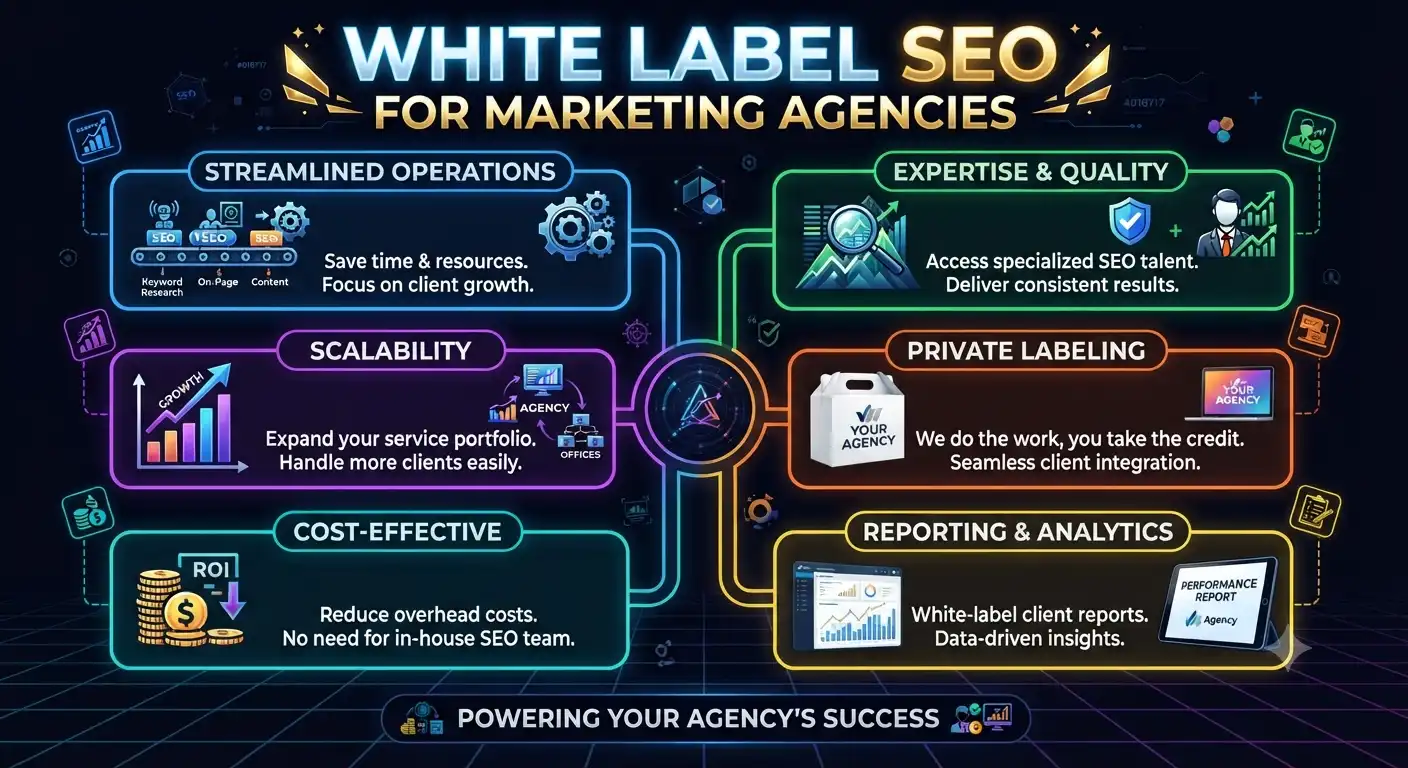
Most marketing agencies lose clients for one reason: they promise SEO results they cannot deliver in-house. Building an internal SEO team costs a US agency specialist roughly $86,000 a year, plus tools, training, and management overhead. That math breaks fast for a small or mid-size agency.
White label SEO solves this problem. It lets your agency sell SEO services, keep 100% of the client relationship, and hand the technical execution to a specialist partner who works quietly behind your brand. Your client never knows a third party exists.
At Rankify, we work on both sides of this equation — as an agency building our own client base, and as a fulfillment partner for agencies that need SEO delivered under their name. This guide covers everything a marketing agency needs to know before choosing, launching, or scaling a white label SEO partnership in 2026.
What Is White Label SEO for Marketing Agencies?
White label SEO is a partnership model where a specialist SEO provider does the strategy, execution, and reporting, while your agency owns the client relationship, the invoice, and the brand.
The client sees your logo on every report. They talk to your account manager. They never see the provider’s name. Behind the scenes, the provider handles keyword research, technical fixes, content production, and link building.
Why “White Label” Instead of “Outsourced”?
Outsourcing usually means handing off a task with little oversight. White labeling is different. The provider works as an extension of your team, follows your brand guidelines, and delivers work formatted exactly as if your own staff produced it.
Who Actually Uses White Label SEO?
Three types of businesses rely on this model most:
- Full-service marketing agencies that offer SEO as one line item among many services
- Web design and development shops that want to upsell ongoing SEO after a website launch
- Solo consultants and small agencies that cannot justify a full-time SEO hire yet
How Does White Label SEO Work? (Step-by-Step)
Understanding the actual workflow removes the biggest hesitation agencies have before signing up.
Step 1: Onboarding. You share client details, goals, and current site access with your provider. A good partner asks for competitor URLs and past SEO history too.
Step 2: Audit and strategy. The provider runs a technical, on-page, and backlink audit, then builds a keyword-tiered roadmap based on search volume and realistic ranking difficulty.
Step 3: Execution. Content gets written, technical issues get fixed, and links get built — all under your branding, with your logo on every deliverable.
Step 4: Reporting. You receive a white-labeled dashboard or PDF report each month. You forward it to the client, or better, you review it first and add your own commentary.
Who Talks to the Client?
You do. Always. This is the entire point of the model. Your account manager stays the single point of contact, which protects your agency’s reputation and pricing power.
How Long Before Results Show?
Most white label SEO campaigns need three to six months before meaningful ranking movement appears, and closer to twelve months for competitive B2B or local niches. Set this expectation with your client on day one to avoid churn.
Types of White Label SEO Services You Can Resell
Not every provider offers the same scope. Before signing a contract, map their service list against what your clients actually need.
- Technical SEO — site speed, Core Web Vitals, crawlability, schema markup, indexation fixes
- On-page and content SEO — keyword mapping, meta data, internal linking, blog and landing page content
- Local SEO — Google Business Profile optimization, citations, review management
- Link building — guest posts, digital PR, HARO-style outreach, niche edits
- Reporting and analytics — branded dashboards, rank tracking, ROI reporting
The strongest agencies bundle at least three of these together, since SEO rarely works as a single isolated task.
White Label Technical SEO Audit Services: Your Foundation
Every successful campaign starts with a technical audit. Skip this step, and content or link building work sits on a broken foundation.
A proper white label technical SEO audit checks Core Web Vitals (LCP under 2.5 seconds, CLS under 0.1, INP under 200ms), crawl errors, duplicate content, canonical tags, mobile usability, and structured data. The provider should hand you a prioritized action list, not just a raw data dump from a tool.
This matters even more in 2026. Google’s algorithm now weighs page experience and structured data more heavily, since AI Overviews and answer engines pull directly from well-marked-up pages. A site with clean schema markup has a real advantage in both traditional rankings and AI-driven search results.
Ask your provider one question before hiring them: “Do you explain what each fix does for rankings, or do you just list problems?” The answer separates a real technical SEO partner from a cookie-cutter reseller.
White Label Content Writing + SEO: Why They Must Be Bundled
Content and SEO cannot live in separate departments. A blog post without keyword strategy behind it rarely ranks. Keyword research without content to support it never converts into traffic.
Sixty-one percent of companies already outsource content marketing, and the demand keeps growing as agencies take on more clients. A white label content writing + SEO service should include:
- Keyword-mapped topic clusters, not random blog ideas
- Hemingway-readable copy with short sentences and active voice
- Yoast-ready structure: clear H1/H2/H3 hierarchy, internal links, meta data
- E-E-A-T signals — author bios, cited sources, real examples
What Separates Good Content From Ranking Content?
Good content reads well. Ranking content also matches search intent exactly, answers the query in the first 100 words, and links internally to related pages that build topical authority. Ask your provider for sample articles before committing, and check whether those samples actually rank.
White Label SEO for Small Agencies: How to Start Without Overhead
Small agencies face a specific trap. They win an SEO client, then realize they have nobody qualified to deliver the work. Hiring a full-time specialist before revenue justifies it is a fast way to burn cash.
White label SEO removes that risk. A small agency can:
- Sell SEO packages immediately, without waiting to hire
- Start with one or two clients and scale the provider relationship as revenue grows
- Keep margins healthy — most agencies mark up white label pricing 40–60% and still stay competitive
- Avoid the HR cost of hiring, training, and benefits for a specialist role
For a two- or three-person agency, this model is often the only realistic path to offering SEO at all.
White Label SEO for Web Design Agencies: A Natural Upsell
Web design and development agencies sit on a goldmine they usually ignore. Every client who just paid for a new website needs ongoing SEO to actually get found on Google. Yet most design agencies stop the relationship at launch day.
Adding white label SEO turns a one-time project into recurring monthly revenue. It also protects your design work — a beautiful site with zero organic traffic reflects poorly on you, even if the design itself was flawless.
The pitch is simple: “We built your site. Now let’s make sure people actually find it.” This single line closes more retainers than any cold outreach campaign.
Web design agencies should prioritize providers strong in technical SEO specifically, since a freshly built site often needs Core Web Vitals tuning, proper redirects from any old URLs, and schema implementation that a design team typically skips.
How to Choose the Right White Label SEO Fulfillment Partner
This decision determines whether white label SEO strengthens your agency or damages your reputation. Evaluate every potential partner against these criteria:
Transparency. They should show you exactly what work happens each month, not just a summary.
Communication speed. A slow provider makes you look slow to your client. Test their response time before signing.
No long-term lock-in. Favor month-to-month agreements over multi-year contracts, especially early in the relationship.
Proven case studies. Ask for real, verifiable examples — not just testimonials with no client names or industries attached.
Scope match. Confirm they cover the specific services your clients need: local SEO, e-commerce SEO, or B2B content, for example.
Communication protocol. Confirm your brand name never appears anywhere on invoices, emails, or reports sent to the client.
A red flag worth remembering: any provider promising guaranteed rankings or a specific position on Google is either inexperienced or dishonest. No one controls Google’s algorithm.
White Label SEO Dashboard Software: Reporting That Builds Trust
Clients rarely churn because rankings move slowly. They churn because they cannot see what they’re paying for. A branded white label SEO dashboard fixes this by showing real-time rank tracking, traffic trends, and completed tasks — all under your logo.
Look for dashboard software that offers:
- White-labeled branding with your agency’s logo, colors, and domain
- Automated monthly report generation, so you’re not building slides manually
- Rank tracking by keyword tier, matched to the strategy the provider built
- Clear task logs showing exactly what work was completed that month
A well-designed dashboard also becomes a sales tool. Showing a prospect a live, branded reporting example during a pitch call builds more trust than any slide deck.
The Role of a White Label SEO White Paper / Case Study in Closing Deals
Prospects rarely buy SEO on promises alone. They buy on proof. A strong white label SEO case study library — provided by your fulfillment partner — becomes one of your most valuable sales assets.
A useful case study shows the starting point, the strategy applied, the timeline, and the actual traffic or ranking outcome. Vague claims like “we grew traffic significantly” convince no one. Specific numbers, even modest ones, build far more credibility.
Ask your provider whether you can white-label their case studies with your own branding for sales decks. Many providers maintain libraries across niches like legal, health, SaaS, and local services — request the ones closest to your target client base.
White Label SEO Pricing Models Explained
Pricing structures vary between providers, and picking the wrong model can quietly kill your margins.
Flat monthly retainer. You pay a fixed fee per client tier — usually based on competition level and scope. This model is easiest to predict and mark up.
Pay-per-deliverable. You pay per article, per audit, or per link placement. This suits agencies with unpredictable client volume, since you only pay for what you use.
Hourly or project-based. Less common for ongoing SEO, but useful for one-off audits or migrations.
Most agencies find the flat retainer model easiest to sell, since it mirrors how they already price their own services to clients. Whichever model you choose, confirm exactly what’s included — some providers count “content” as a single 500-word post, while others include full topic clusters.
How Should You Mark Up White Label SEO?
A 40–60% markup is standard across the industry. Price too low, and clients start questioning your value. Price too high without added service — strategy calls, custom reporting commentary, dedicated account management — and you risk losing deals to agencies with tighter margins.
Common Mistakes Agencies Make with White Label SEO
Avoiding these errors saves both money and client relationships.
Choosing on price alone. The cheapest provider often cuts corners on content quality or link sources, which risks Google penalties down the line.
Skipping the technical audit. Jumping straight to content or links without fixing technical issues wastes budget.
Failing to review reports before forwarding. Sending an unreviewed report straight to the client removes your value-add and risks confusing jargon reaching someone who doesn’t understand SEO terminology.
No clear internal ownership. Someone on your team must own the provider relationship, or communication gaps start costing you client trust.
Ignoring niche relevance. A provider with no experience in your client’s industry — legal, health, SaaS — will need a learning curve you’re paying for.
How to Measure ROI on White Label SEO Before Your Client Asks
Clients eventually ask “is this working?” Agencies who answer with real numbers keep the account. Agencies who answer with vague reassurance lose it.
Track these metrics monthly, separate from whatever the provider sends you:
- Organic traffic growth, pulled directly from Google Search Console, not just the provider’s dashboard
- Keyword ranking movement across the specific tiers targeted in the original strategy, not vanity keywords
- Conversion actions tied to organic traffic — form fills, calls, or purchases — since rankings alone don’t pay client bills
- Backlink profile growth, checked against toxic or spammy link warnings
Cross-checking your provider’s numbers against Search Console data, even briefly each month, protects you from ever presenting inflated figures to a client. It also signals to your provider that you’re paying attention, which tends to improve the quality of work you receive.
Frequently Asked Questions
Is white label SEO the same as SEO reseller programs? They overlap heavily. “White label” emphasizes that the work is unbranded and delivered under your name, while “reseller” emphasizes the pricing and packaging structure. Most providers use the terms interchangeably.
How much does white label SEO cost for an agency? Pricing varies by scope, but most providers charge wholesale rates that let agencies mark up 40–60% and still remain competitive against local SEO firms.
Will my client ever find out I’m using a white label provider? Not if you choose a reputable partner. Reports, invoices, and emails should carry only your branding. Confirm this in writing before signing any contract.
Can white label SEO work for local businesses, not just B2B? Yes. Many providers specialize in local SEO — Google Business Profile optimization, citations, and review management — which fits small business and service-area clients particularly well.
What if the white label provider’s work underperforms? Review their reporting cadence and ask for a strategy adjustment meeting. A reliable partner should offer a satisfaction guarantee or trial period, so confirm this before signing a long-term agreement.
How many clients can one white label SEO relationship support? Most providers scale from a single client to hundreds without requiring you to change contracts. Confirm this flexibility upfront if you expect rapid growth, since some providers cap capacity per partner.
Does white label SEO help with AI search visibility, not just Google rankings? Increasingly, yes. Strong providers now optimize for AI Overviews, ChatGPT, and Perplexity citations alongside traditional rankings, since structured, well-cited content performs better across both traditional and AI-driven search in 2026.
Conclusion
White label SEO gives marketing agencies a realistic path to offering SEO without the cost, risk, or delay of building an in-house team. The model works best when you choose a transparent fulfillment partner, bundle technical audits with content and reporting, and keep full control of the client relationship at every step.
Whether you run a small two-person agency or a web design shop looking to add recurring revenue, the right white label SEO partnership turns a service gap into a growth engine — without your clients ever knowing the difference.

Asrar Ahmad is the founder and lead SEO strategist at Rankify SEO & AI Agency, with 4+ years of experience in technical, on-page, and off-page SEO for US and UK clients. He specializes in topical authority building, keyword strategy, and data-driven content that ranks and converts.