
If you’re comparing customer support tools for your online store, you’ve probably come across Tidio. In this Tidio review, we cover what the platform does in 2026. We look at what it costs. And we answer whether Lyro, Tidio’s AI agent, is worth adding to your support stack.
We’ve used Tidio directly in our own AI automation work with ecommerce clients. This isn’t a rehash of the marketing page. It’s what we’ve actually found useful, and what’s worth knowing before you sign up.
Want to try it yourself first? You can create a free Tidio account here. No credit card required.
What Is Tidio?
Tidio is a customer service platform built primarily for ecommerce brands. It combines live chat, a shared team inbox, and AI-powered automation in one dashboard. It connects directly with Shopify, WooCommerce, and most major helpdesks. That means store owners can add it without rebuilding their existing support workflow.
Tidio’s positioning has shifted over the past year. It’s no longer just a live chat widget. The bigger story now is Lyro, Tidio’s AI agent, which has become the core of the platform.
Lyro AI: The Part That Actually Matters
Lyro is Tidio’s AI customer support agent. It’s the main reason Tidio has become a serious option for growing stores, not just a chat widget add-on.
Here’s what Lyro actually does:
- Resolves conversations automatically. On average, Lyro resolves 67% of incoming conversations without a human agent stepping in. Think order status, shipping questions, and return policy queries.
- Learns from your store’s content. Lyro trains on your product pages, FAQs, and policies. That means answers are specific to your store, not generic.
- Works on top of your existing setup. You don’t need to migrate away from Zendesk, Gorgias, or whatever helpdesk you use now. Lyro layers on top of it.
- Escalates when it should. Complaints, refund exceptions, and anything nuanced get routed to your support team. The AI doesn’t try to force an answer it isn’t sure of.
For a store with a high volume of repetitive tickets, that 67% resolution rate matters. It translates directly into hours of support time saved every week. And customers don’t notice a drop in response quality.
Tidio Pricing in 2026
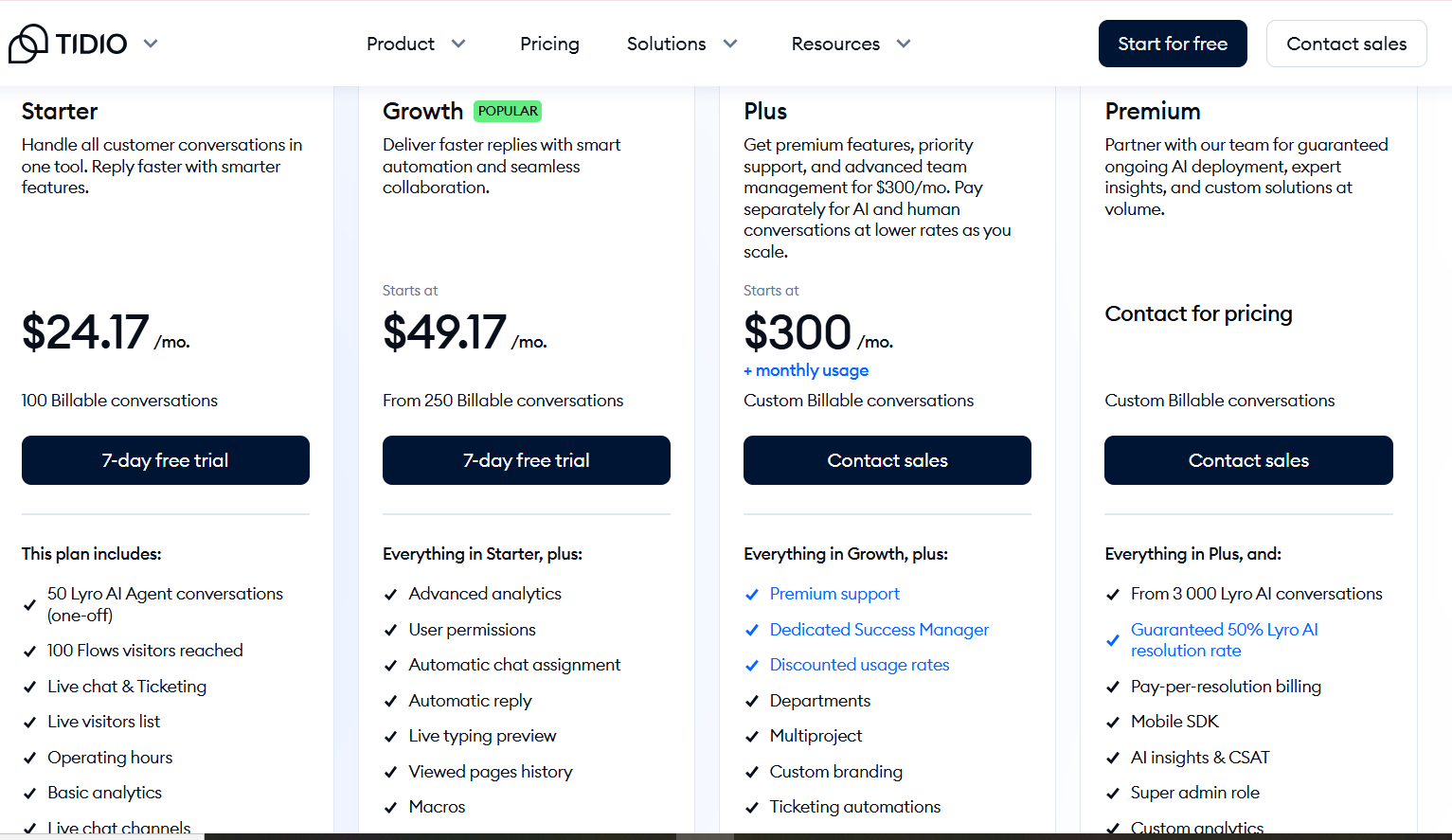
Tidio’s pricing mixes subscription tiers with usage-based AI conversation costs. Here’s the current breakdown as of 2026:
- Free — $0/mo. Basic live chat and limited automation. Good for very small stores just getting started.
- Starter — from $24.17/mo. Handles all customer conversations in one tool, with faster replies and smarter features.
- Growth — from $49.17/mo. Adds faster replies, smart automation, and seamless team collaboration.
- Plus — from $300/mo plus monthly usage. Premium features, priority support, and advanced team management, with AI and human conversations billed separately at lower rates as you scale.
- Premium — contact sales for pricing. Guaranteed ongoing AI deployment, expert insights, and custom solutions at volume.
- Lyro AI add-on — from $32.50/mo, which works out to roughly $0.50 per conversation. Lyro bills for every conversation it replies to, whether or not it fully resolves it — so this is a “per conversation” cost, not a “per resolution” cost. That’s still notably lower than comparable AI tools from Zendesk ($1.00–$2.00) and Intercom Fin ($0.99).
Lyro’s pricing is usage-based, not a flat monthly fee. So the cost scales naturally with your actual support volume. You’re not paying for capacity you don’t use, and the cost stays proportional as your store grows.
Tidio Feature Overview
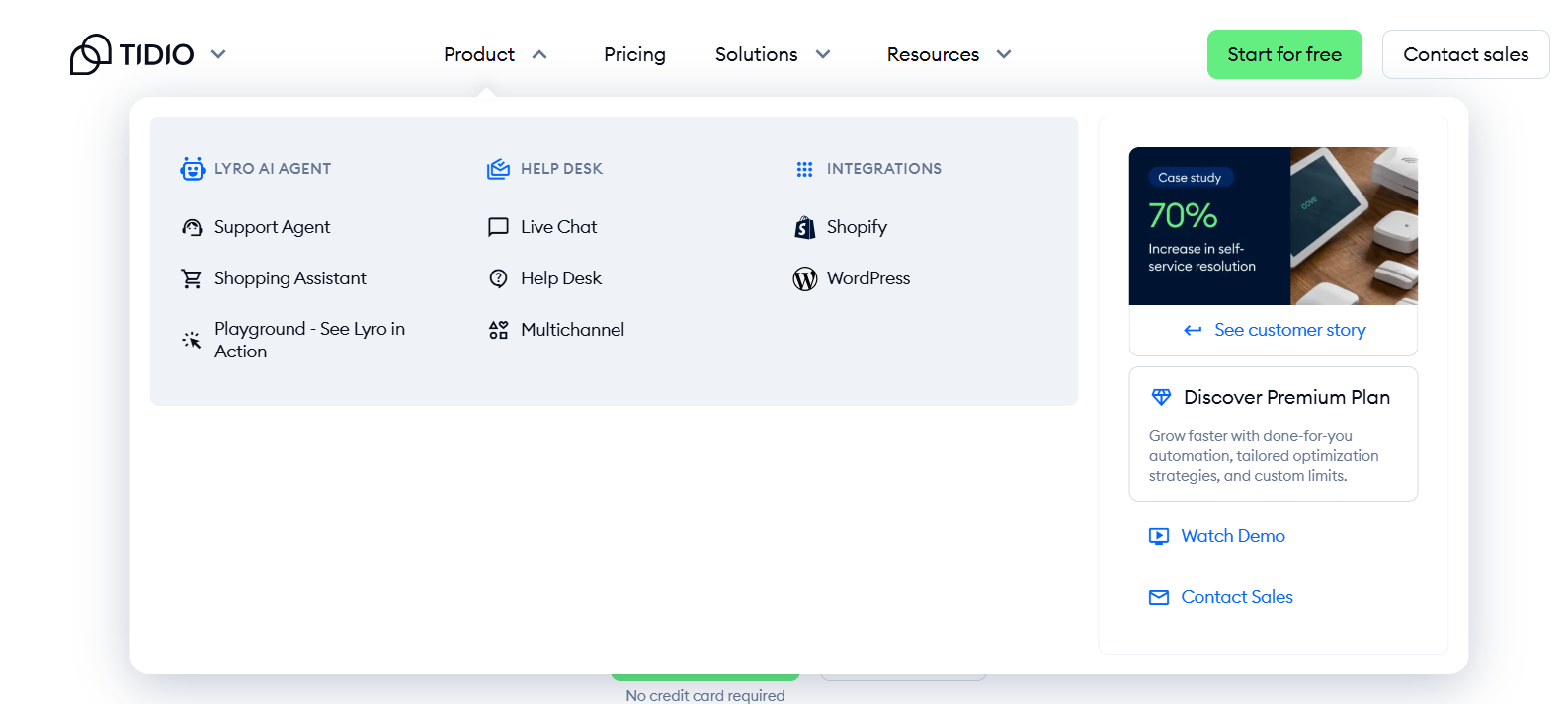
Beyond Lyro, Tidio’s core dashboard includes:
- Live chat widget — customizable to match your store’s branding, with real-time visitor tracking.
- Shared team inbox — consolidates chat, email, and social messages in one place. Nothing gets missed across channels.
- Multichannel support — connects with Messenger, Instagram, and email alongside your website chat.
- Automation flows — rule-based triggers for common scenarios, like cart abandonment messages. These work alongside Lyro’s AI responses.
- Analytics dashboard — tracks resolution rates, response times, and conversation volume. You can see what’s actually working.
Who Tidio Is Actually Good For
Based on our work with ecommerce clients, Tidio makes the most sense for:
- Shopify and WooCommerce stores with a support team of roughly 5–15 agents, dealing with a growing volume of repetitive tickets.
- Store owners who don’t want to migrate helpdesks just to get AI support. Lyro layers onto your existing setup instead.
- Teams that want usage-based AI pricing rather than a flat fee regardless of actual conversation volume.
It’s less of a fit for very large enterprise support operations. If your workflows are highly complex and span multiple departments, a heavily customized enterprise platform might make more sense.
Is Tidio Worth It in 2026?
Weigh the pricing, Lyro’s resolution rate, and the fact that it doesn’t require ripping out your existing helpdesk. Tidio comes out as one of the more practical AI customer support options available for ecommerce stores right now. A genuinely competitive per-conversation cost, paired with a no-migration setup, is what sets it apart from larger, more enterprise-focused alternatives.
Is your support team spending most of its day answering the same handful of questions? It’s worth testing Tidio against your own numbers. Don’t just take any review’s word for it — including this one.
Frequently Asked Questions
Does Tidio work with Shopify? Yes. Tidio has a direct Shopify integration. It’s widely used by Shopify store owners for both live chat and AI-powered support.
How much does Lyro AI cost? Lyro AI conversations cost approximately $0.50 per conversation. This is on top of Tidio’s base subscription plan.
Do I need to switch helpdesks to use Tidio? No. Tidio and Lyro AI work alongside your existing helpdesk. There’s no need to replace it.
What percentage of conversations does Lyro resolve automatically? On average, Lyro resolves around 67% of customer conversations without any human involvement.
Want to see Lyro handle your store’s support questions for yourself? Sign up for Tidio here and try it free.
Need help setting up AI-powered customer support the right way? Get in touch with Rankify SEO & AI Agency.

Asrar Ahmad is the founder and lead SEO strategist at Rankify SEO & AI Agency, with 4+ years of experience in technical, on-page, and off-page SEO for US and UK clients. He specializes in topical authority building, keyword strategy, and data-driven content that ranks and converts.