
Running a small business in today’s digital landscape comes with a unique set of challenges. Between managing daily operations, fulfilling customer needs, and controlling costs, finding time for digital marketing often takes a backseat. Yet, over 93% of online experiences begin with a search engine. When prospective customers search for local services or products, appearing on page one of Google is no longer optional—it is essential for survival and growth.
This comprehensive guide breaks down everything you need to know about partnering with an SEO agency for small business. You will learn how modern search engine optimization works, why specialized small business SEO differs from enterprise strategies, what services you should demand, how much to budget, and how to select a trustworthy partner that delivers measurable return on investment (ROI).
What is a Small Business SEO Agency and Why Do You Need One?
A small business SEO agency is a specialized digital marketing agency that focuses on optimizing small to medium-sized business (SMB) websites to increase their organic visibility on search engines like Google, Bing, and DuckDuckGo.
Unlike general digital marketing firms that split focus across social media ads, public relations, and print collateral, a dedicated SEO agency concentrates on non-paid organic search traffic.
+-----------------------------------------------------------------------+
|                    MODERN SMALL BUSINESS SEO                          |
+-----------------------------------+-----------------------------------+
|            FOUNDATION             |             VISIBILITY            |
|  • Technical Site Health          |  • Local Maps Pack (GBP)          |
|  • Speed & Mobile UX              |  • Conversational AI Overviews    |
|  • Structured Schema Data         |  • Organic SERP Keyword Rankings  |
+-----------------------------------+-----------------------------------+
|            AUTHORITY              |             CONVERSION            |
|  • E-E-A-T & Trust Signals        |  • High-Intent Landing Pages      |
|  • High-Quality Local Backlinks   |  • Clear Calls to Action (CTAs)   |
+-----------------------------------+-----------------------------------+
Small Business SEO vs. Enterprise SEO
Small business SEO differs significantly from enterprise-level search engine optimization:
| Feature | Small Business SEO | Enterprise SEO |
|---|---|---|
| Primary Goal | Local dominance, high-intent leads, phone calls | Brand awareness, global market share, high volume traffic |
| Geographic Scope | Local city, radius, or specific regions | National or international markets |
| Target Keywords | Hyper-targeted, high-conversion long-tail keywords | High-volume, highly competitive head terms |
| Core Focus Area | Local SEO, Google Business Profile, local citations | Scalable technical infrastructure, complex subdomains, thousands of pages |
| Budget Range | $500 – $3,500 / month | $10,000 – $50,000+ / month |
Why DIY SEO Often Fails for Small Businesses
Many entrepreneurs attempt to handle SEO in-house using basic plugins or automated templates. While DIY efforts can establish a basic online presence, they usually stall for three reasons:
- Algorithm Complexity: Google updates its search algorithms thousands of times a year. Keeping pace requires continuous study and adjustment.
- Resource Constraints: Proper SEO demands specialized tools (such as Ahrefs, Semrush, and Screaming Frog) that can cost hundreds of dollars per month, along with expertise in web development, copywriting, and link building.
- Execution Gap: Keyword research is straightforward, but technical audit resolution, semantic content creation, and white-hat link acquisition demand substantial manual effort.
Working with an experienced SEO agency bridges this gap, allowing business owners to focus on what they do best: running their business.
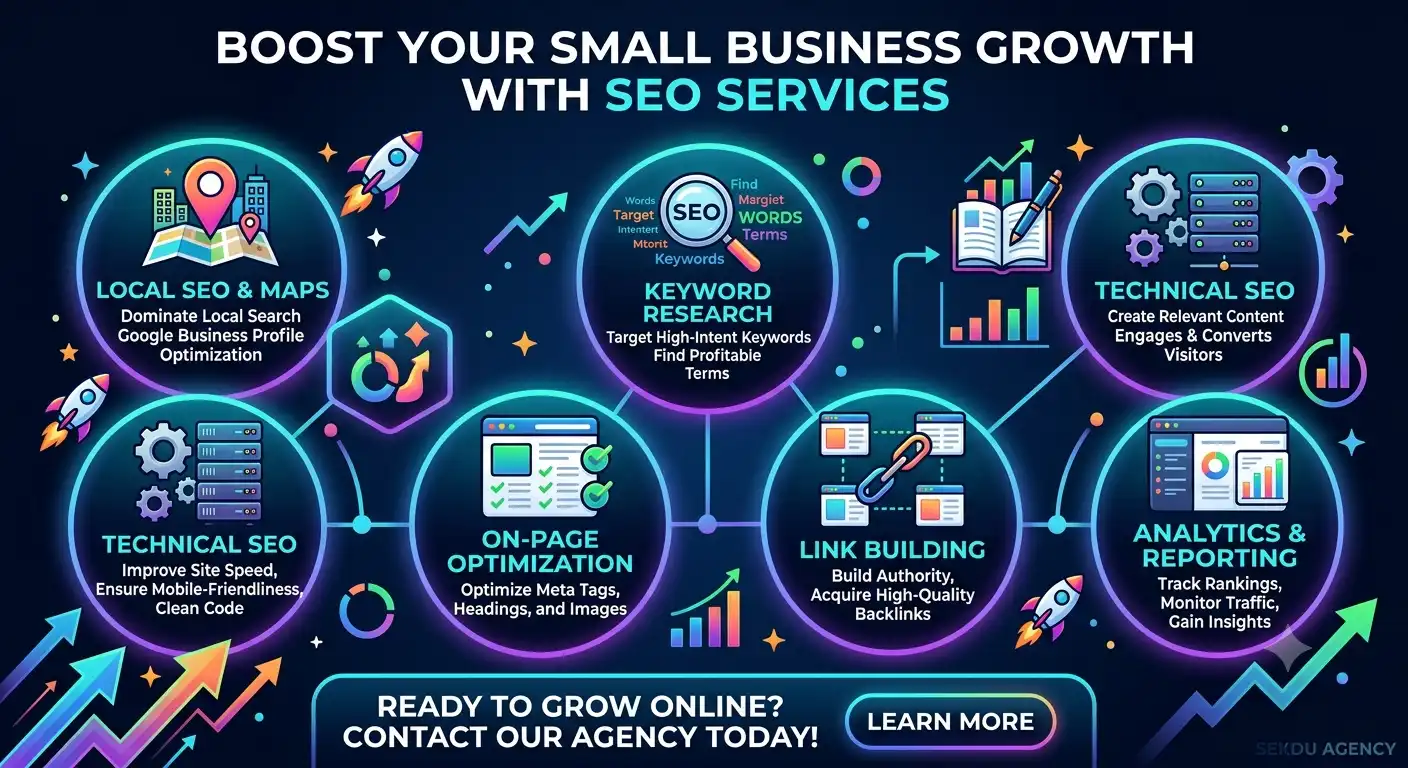
The 6 Pillars of Complete Small Business SEO Services
A full-service SEO strategy must address every aspect of search engine performance. A reputable agency will build a custom strategy covering six primary pillars.
                     +---------------------------+
                     |  Modern 6-Pillar SEO      |
                     +-------------+-------------+
                                   |
        +------------------+-------+-------+------------------+
        |                  |               |                  |
+-------v-------+  +-------v-------+-------v-------+  +-------v-------+
|  1. Local SEO |  | 2. On-Page    | 3. Technical  |  | 4. Off-Page   |
|   & GBP Maps  |  |  & Content    |   & Web UX    |  |  & Authority  |
+---------------+  +---------------+---------------+  +---------------+
        |                                                     |
+-------v-------+                                     +-------v-------+
| 5. E-Commerce |                                     | 6. AI Search  |
|   Optimization|                                     |    (GEO)      |
+---------------+                                     +---------------+
1. Local SEO & Google Business Profile (GBP) Optimization
For brick-and-mortar stores, local service providers, and regional businesses, Local SEO is the single highest-converting digital channel. Over 46% of all Google searches have local intent (e.g., “plumber near me” or “best dentist in [city]”).
An agency optimizing for local search will execute:
- Google Business Profile (GBP) Optimization: Complete setup and verification, primary and secondary category selection, geo-tagged image uploads, and regular GBP updates.
- NAP Consistency: Ensuring your Business Name, Address, and Phone number match identically across online directories (Yelp, YellowPages, Bing Places, Apple Maps).
- Local Citation Building: Submitting your business details to respected regional and industry-specific business directories.
- Review Generation Strategy: Establishing ethical workflows to collect verified customer reviews on Google and handle negative feedback constructively.
2. On-Page SEO & Content Strategy
On-Page SEO involves optimizing individual web pages so search engines understand their context and relevance to user queries.
Key On-Page elements include:
- Semantic Keyword Research: Identifying search queries based on search intent (Informational, Commercial, Transactional, Navigational).
- Title Tags and Meta Descriptions: Crafting compelling, keyword-optimized titles and description tags that improve Click-Through Rate (CTR).
- Heading Hierarchy (H1, H2, H3): Structuring content so human readers can scan easily and crawlers can grasp topic architecture.
- Internal Linking Infrastructure: Connecting relevant blog posts and core landing pages to pass authority (PageRank) across the site.
- Copywriting for E-E-A-T: Authoring rich, original content that reflects Experience, Expertise, Authoritativeness, and Trustworthiness.
3. Technical SEO & Web Performance
If search engine crawlers cannot easily index your website, even the best content will fail to rank. Technical SEO forms the infrastructure supporting your digital presence.
A thorough technical SEO strategy covers:
- Core Web Vitals & Page Speed: Optimizing Largest Contentful Paint (LCP), Interaction to Next Paint (INP), and Cumulative Layout Shift (CLS) for fast loading times.
- Mobile-First Indexing: Ensuring complete responsiveness and smooth layout across all device viewports.
- Crawlability and Indexability: Managing
robots.txtfiles, XML sitemaps, canonical tags, and fixing 404 page errors or 301 redirect chains. - Structured Data (Schema Markup): Implementing
LocalBusiness,Organization,Service,Product, andFAQPageJSON-LD schema so search engines display rich snippets.
4. Off-Page SEO & Authority Building
Google relies on external signals to measure site trust and authority. The primary metric remains high-quality backlinks—links pointing to your domain from other reputable websites.
Ethical Off-Page strategies include:
- Digital PR and Outreach: Pitching local journalists, industry blogs, and podcasts to earn authentic editorial mentions.
- Local Community Sponsorships: Partnering with local charities, sports teams, or community events to earn local, authoritative links.
- Guest Publishing: Creating high-value articles for recognized industry publications.
- Unlinked Brand Mention Reclaim: Finding online mentions of your business name and reaching out to convert them into clickable backlinks.
5. E-commerce SEO & Product Optimization
For small businesses selling products online via Shopify, WooCommerce, BigCommerce, or Magento, e-commerce SEO brings direct revenue.
E-commerce SEO strategies cover:
- Product & Category Page Optimization: Targeting long-tail transactional terms (e.g., “handmade leather wallet brown”).
- Image SEO: Optimizing image file sizes, alt tags, and filenames for fast load speeds and Google Image search visibility.
- Faceted Navigation Management: Preventing duplicate content issues caused by product filter parameters (color, size, price).
- Merchant Center & Product Schema: Integrating structured product data to display price, availability, and review stars directly in search results.
6. AI Search Optimization (GEO & SGE)
Search is evolving beyond simple link listings. AI-powered platforms such as Google AI Overviews, ChatGPT, Gemini, and Perplexity are changing how users discover answers.
Generative Engine Optimization (GEO) ensures your small business stays visible in AI-synthesized responses by:
- Publishing direct, expert answers to specific audience questions.
- Structuring data cleanly using semantic HTML and bullet points.
- Building strong brand entity footprints across third-party review platforms and industry sites.
Key Benefits of Hiring an SEO Agency for Small Business
Investing in professional SEO services provides predictable, long-term returns for growing companies.
   PPC ADVERTISING                     ORGANIC SEO
+-------------------+              +-------------------+
| Traffic Spike     |              | Compound Traffic  |
| (Active Spending) |              | Growth            |
|                   |              |                   |
|                   |              |  /----------------|
|                   |              | /                 |
|                   |              |/                  |
+-------------------+              +-------------------+
  Stops when budget                  Keeps growing after
   runs out.                          initial effort.
1. Higher ROI Than Paid Advertising
While Pay-Per-Click (PPC) ads offer immediate traffic, costs instantly cease the moment your daily ad budget exhausts. In competitive industries, cost-per-click (CPC) rates can exceed $15 to $50 per click.
SEO builds a durable digital asset. Once your website ranks organically on page one, incoming organic visits incur no per-click fees, dramatically lowering customer acquisition costs over time.
2. Sustainable, Compounding Organic Growth
High-quality content and authoritative backlinks do not expire. A well-optimized service landing page or informational guide published today can continue generating organic leads for years with periodic maintenance.
3. Increased Conversion Rates
SEO is inherently high-intent marketing. Unlike push marketing (such as social media ads or radio commercials that interrupt users), SEO captures users who are actively searching for a solution to their immediate problem. Users arriving via search engines arrive ready to take action.
4. Competitive Advantage Over Local Rivals
Many local small businesses neglect modern SEO practices, relying solely on legacy word-of-mouth or basic social media profiles. Engaging a dedicated agency allows you to capture dominant search visibility before your competitors adapt.
SEO Costs & Pricing Models for Small Businesses
Understanding industry standards helps you avoid predatory pricing or underfunded campaigns that produce no results.
+------------------------------------------------------------------------+
|                 SMALL BUSINESS SEO PRICING TIERS                       |
+-------------------+--------------------+-------------------------------+
| MODEL             | TYPICAL COST       | BEST FOR                      |
+-------------------+--------------------+-------------------------------+
| Monthly Retainer  | $500 – $3,500 / mo | Sustainable, ongoing growth   |
| Project-Based     | $1,500 – $7,500    | Audits, redesigns, setups     |
| Hourly Consulting | $75 – $200 / hr    | Specific expert guidance      |
+-------------------+--------------------+-------------------------------+
Standard Pricing Breakdown
- Monthly Retainer ($500 – $3,500 / month):
- The most common and effective model.
- Covers ongoing technical monitoring, content creation, local map management, link building, and monthly reporting.
- $500–$1,000/mo: Ideal for single-location local businesses in low-to-medium competition markets.
- $1,500–$3,500/mo: Ideal for regional companies, multi-location brands, e-commerce stores, or high-competition niches (legal, medical, home services).
- Project-Based Pricing ($1,500 – $7,500):
- One-time fee for a defined scope of work.
- Common projects include full technical SEO audits, website migrations, Google Business Profile setups, or local citations cleanups.
- Hourly Consulting ($75 – $200 / hour):
- Best for small businesses with an in-house team seeking expert strategy oversight or periodic technical troubleshooting.
Red Flags: Cheap SEO Packages ($99–$299/month)
Be cautious of agencies offering full-service SEO for $99 to $299 per month. Quality SEO requires skilled human hours for strategic research, custom writing, web development, and manual link outreach.
Low-cost services frequently rely on dangerous shortcuts, such as automated spam link networks, scraped content, or offshore bot traffic, which can trigger severe Google penalties.
How to Choose the Right SEO Agency: A Step-by-Step Framework
Selecting the right partner requires thorough evaluation. Follow this structured process to evaluate prospective agencies.
+-------------------------------------------------------------------+
|               5-STEP AGENCY SELECTION FRAMEWORK                   |
+-------------------------------------------------------------------+
|  Step 1: Define Goals & Budget                                    |
|  Step 2: Request Verified Case Studies                            |
|  Step 3: Interview Agencies & Test Transparency                   |
|  Step 4: Audit Their Own SEO & Online Reputation                  |
|  Step 5: Review Contract Terms & KPI Metrics                      |
+-------------------------------------------------------------------+
Step 1: Define Your Goals and Metrics
Before contacting agencies, clarify your objectives:
- Are you trying to get more phone calls from local customers?
- Do you want to sell more products online nationally?
- Are you launching a new website that needs indexation and brand footprint?
Step 2: Request Industry Case Studies and Proof
Ask agencies for case studies featuring clients in your industry or businesses with similar target audiences. Look for verified growth metrics:
- Organic traffic increases.
- Conversion growth (form fills, calls, sales) rather than just “vanity rankings.”
- Key performance indicators spanning at least 6 to 12 months.
Step 3: Ask the Essential Interview Questions
During consultation calls, ask the following critical questions:
- “What specific tactics will you use for my business in the first 90 days?”
- Good Answer: Detailed explanation of technical audits, local GBP setup, competitor gap analysis, and content planning.
- Bad Answer: Vague promises of “secret sauce tactics” or bulk link packages.
- “How do you measure campaign success?”
- Good Answer: Revenue, lead generation, organic conversion rates, and primary keyword movements.
- Bad Answer: Focusing solely on impressions or total indexed pages.
- “What tools do you use for auditing and tracking?”
- Good Answer: Industry standards like Google Analytics 4 (GA4), Google Search Console (GSC), Ahrefs, Semrush, Screaming Frog, and BrightLocal.
- “How frequently will we communicate, and what does reporting look like?”
- Good Answer: Monthly custom reporting calls paired with live analytics dashboards and dedicated account managers.
Step 4: Watch Out for Agency Red Flags
Avoid agencies that display any of these warning signs:
- 🚩 Guaranteed #1 Rankings on Google: Google explicitly states no agency can guarantee a #1 rank due to personalized search, algorithm updates, and shifting market competition.
- 🚩 Proprietary/Secret Link Networks: High risk of search engine penalties.
- 🚩 Ownership of Assets: Ensure you retain complete ownership of your domain, website, Google Analytics, Google Search Console, and Google Business Profile.
- 🚩 Long-Term Lock-in Contracts Without Exit Clauses: Reliable agencies retain clients through proven monthly performance, not restrictive 12-month lock-ins without performance milestones.
How SEO Agencies Build E-E-A-T for Small Businesses
Google’s Quality Rater Guidelines emphasize E-E-A-T: Experience, Expertise, Authoritativeness, and Trustworthiness. This is crucial for small businesses operating in “Your Money or Your Life” (YMYL) niches, such as healthcare, finance, legal, and home construction.
                   +---------------------------+
                   |         E-E-A-T           |
                   |      BUILDING BLOCKS      |
                   +-------------+-------------+
                                 |
         +-----------------------+-----------------------+
         |                                               |
+--------v--------+                             +--------v--------+
|   EXPERIENCE    |                             |    EXPERTISE    |
| First-hand work |                             | Qualifications  |
| & Case studies  |                             | & Proof points  |
+--------+--------+                             +--------+--------+
         |                                               |
         +-----------------------+-----------------------+
                                 |
         +-----------------------+-----------------------+
         |                                               |
+--------v--------+                             +--------v--------+
| AUTHORITATIVE   |                             | TRUSTWORTHINESS |
| Industry press  |                             | Reviews, SSL,   |
| & Backlinks     |                             | Clear Policies  |
+-----------------+                             +-----------------+
Practical E-E-A-T Implementation Strategies
- Detailed Author & Team Biographies: Highlighting founder credentials, certifications, years of industry experience, and professional awards.
- Customer Reviews and Case Studies: Displaying authentic customer testimonials, video reviews, and project photos directly on core landing pages.
- Transparent Business Information: Providing clear physical address details, contact forms, refund/privacy policies, and active phone numbers in website footers.
- Structured Entity Building: Utilizing Schema.org markup to link your website to official social media profiles, Wikipedia/Wikidata entities, and trade organization directories.
Measuring ROI: What to Expect and When to Expect It
SEO is a long-term compound strategy. Setting realistic timeline expectations prevents premature cancellation of successful campaigns.
[Month 1-2] ----------> [Month 3-4] ----------> [Month 5-6] ----------> [Month 7-12+]
Audit & Fixes          Initial Indexation       Traffic Growth          Compound ROI &
Technical Foundation   Keyword Movement         Lead Increase           Market Leadership
The Standard Small Business SEO Timeline
- Months 1–2 (Foundation & Setup): Comprehensive site audit, technical bug fixes, Google Search Console & GA4 alignment, keyword research, and Google Business Profile cleanup.
- Months 3–4 (Execution & Early Movement): On-page optimization, publishing high-intent service content, initial local citation building. Keywords begin moving from page 5+ into pages 2–3.
- Months 5–6 (Traffic Acceleration): Keywords reach page 1. Organic website traffic grows noticeability. Phone calls, lead forms, and sales inquiries begin steadily increasing.
- Months 7–12+ (Authority & Market Leadership): Compounding revenue growth. Expanded ranking coverage across secondary keywords. Consolidation of top positions against competitors.
Frequently Asked Questions (FAQs)
1. Is hiring an SEO agency worth it for a small business?
Yes. For most small businesses, organic search produces a higher long-term ROI than paid ads or traditional print marketing. Partnering with an agency gives you access to a team of experts—including developers, strategists, copywriters, and link builders—for a fraction of the cost of hiring a single full-time employee.
2. How long does it take for a small business to rank on Google?
Most small business websites begin seeing preliminary keyword movements within 60 to 90 days. Significant organic traffic and revenue growth typically manifest between months 4 and 6, while competitive niches may require 9 to 12 months of consistent optimization.
3. Can a small business compete with national brands on Google?
Yes. National brands rarely optimize effectively for hyper-local queries. By leveraging Local SEO, localized schema markup, targeted long-tail keywords, and Google Business Profile optimization, small businesses can regularly outrank major corporations in their local market area.
4. What is the difference between an SEO agency and a web design company?
Web designers focus on layout, visual aesthetics, and brand identity. SEO agencies focus on site structure, search intent, technical performance, search engine indexing, and lead generation. While many web design agencies build visually attractive sites, they often lack the technical expertise needed to make those sites rank on Google.
5. Will AI search tools like ChatGPT and Google AI Overviews destroy small business SEO?
No, but they do change how SEO is practiced. AI platforms cite authoritative, trusted web sources when generating answers. Businesses that build strong brand entities, focus on E-E-A-T, and implement proper structured schema will continue to be cited and recommended by AI engines.
Conclusion & Action Plan for Small Business Owners
In 2026 and beyond, search engine optimization is the foundation of sustainable small business growth online. Rather than treating SEO as an expense, forward-thinking business owners view it as a high-return investment that builds long-term digital authority.
To get started:
- Conduct an honest assessment of your current website performance using free tools like Google Search Console and Google PageSpeed Insights.
- Determine a realistic monthly SEO budget based on your target market size and customer lifetime value (LTV).
- Schedule consultations with at least three reputable small business SEO agencies, asking for case studies and transparent reporting workflows.
By selecting an agency that aligns with white-hat practices, clear communication, and customer-focused metrics, your small business can achieve page-one visibility, dominate your local market, and enjoy consistent, compounding revenue growth.

Asrar Ahmad is the founder and lead SEO strategist at Rankify SEO & AI Agency, with 4+ years of experience in technical, on-page, and off-page SEO for US and UK clients. He specializes in topical authority building, keyword strategy, and data-driven content that ranks and converts.