
Choosing the right partner to improve your organic search visibility can feel overwhelming. As search engines evolve with artificial intelligence, semantic understanding, and complex algorithm updates, the stakes are higher than ever.
Many business owners use the terms “SEO Company” and “SEO Agency” interchangeably. On the surface, both promise higher Google rankings, increased organic traffic, and better online visibility. However, beneath the surface lies a fundamental difference in organizational structure, strategic depth, service scope, and client relationship models.
Choosing between an SEO company and an SEO agency can determine whether you receive a standard, execution-based checklist or a holistic, revenue-driven marketing strategy.
In this comprehensive guide, we will unpack the real differences between an SEO company and an SEO agency, analyze pricing models, compare in-house versus external options, and provide an actionable decision framework to help you choose the ideal search marketing partner for your business goals.
Semantic Definitions: SEO Company vs. SEO Agency
To make an informed decision, you must first understand the structural and operational definitions of both service models.
What is an SEO Company?
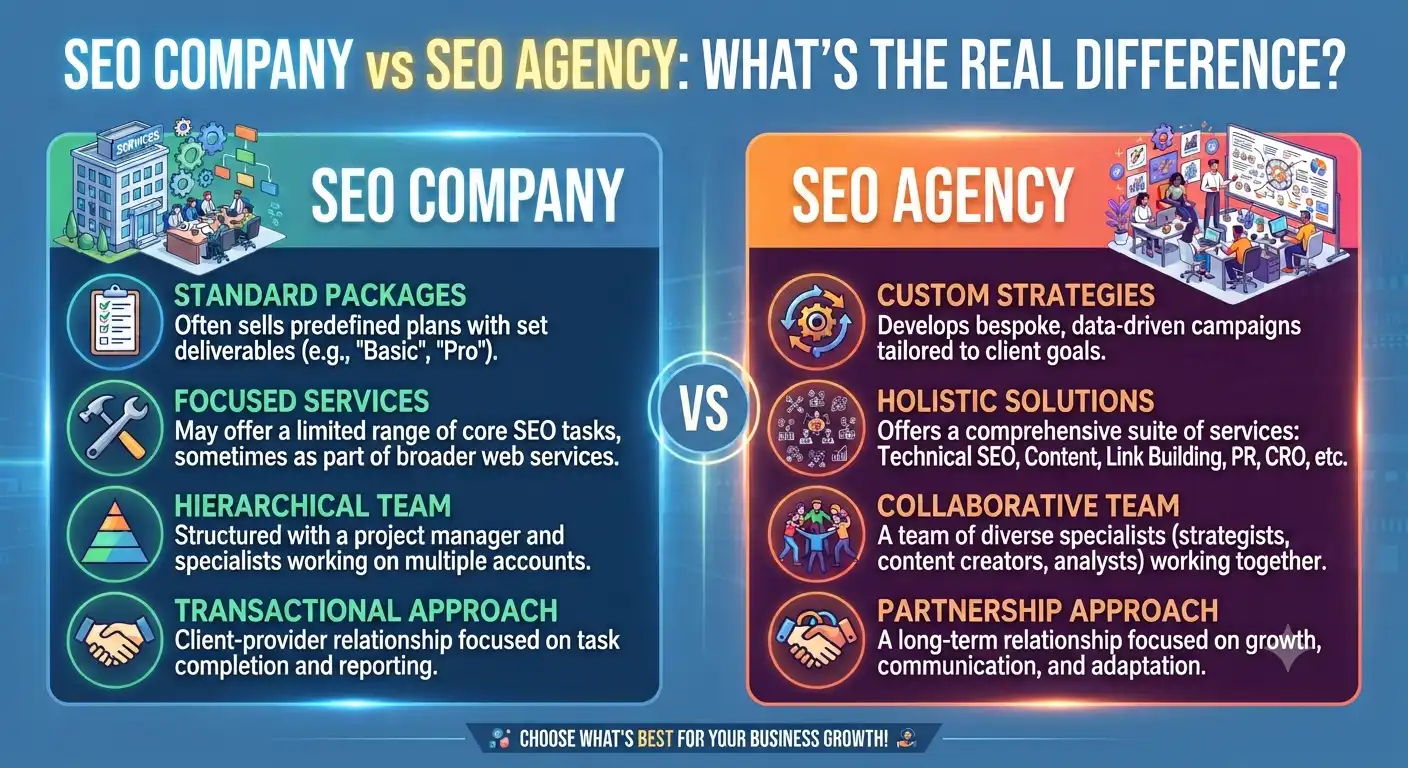
An SEO Company is typically a specialized entity focused on task execution, tactical optimization, and direct deliverables. SEO companies often operate on a productized service model. They focus on executing specific, highly defined search engine optimization tasks efficiently and at scale.
Key characteristics of an SEO company include:
- Focus on Specific Tasks: Specialized execution in technical SEO audits, link building, local citation building, or on-page optimization.
- Standardized Workflows: Streamlined processes that deliver predictable, volume-based outputs.
- Lean Structure: Direct, task-focused team configurations without extensive account management layers.
- Transactional Relationship: High efficiency with clear, project-based or deliverable-driven scopes.
What is an SEO Agency?
An SEO Agency is a full-service or multi-disciplinary strategy firm that integrates search engine optimization into a broader business growth framework. An agency approaches search visibility as part of a multi-channel digital strategy, aligning organic performance with customer acquisition funnels, conversion rate optimization (CRO), content strategy, and brand authority.
Key characteristics of an SEO agency include:
- Holistic Strategy: Custom-built strategies tailored to business revenue, audience intent, and long-term search engine authority.
- Multi-Disciplinary Expertise: Dedicated specialists across technical SEO, content strategy, digital PR, data analytics, and user experience (UX).
- Consultative Partnership: Dedicated account managers, regular strategic reviews, and ongoing collaboration with your internal marketing team.
- Adaptability: Custom solutions designed for complex, changing search landscapes, such as Google AI Overviews and Helpful Content updates.
SEO Company vs SEO Agency: Core Differences Breakdown
While both partners aim to increase your organic search performance, their internal operations, methodologies, and execution styles differ significantly.
| Feature / Metric | SEO Company | SEO Agency |
|---|---|---|
| Primary Focus | Tactical execution and specific SEO deliverables | Business strategy, brand authority, and revenue growth |
| Team Structure | Lean teams, tactical specialists, direct technicians | Multi-disciplinary teams (Analysts, Strategists, PR, Writers, Developers) |
| Service Scope | Specialized (e.g., technical audits, backlink packages) | Integrated (Technical, Content, Digital PR, CRO, Analytics) |
| Client Relationship | Direct, task-oriented, deliverable-driven | Consultative, partner-level, high communication |
| Customization | Standardized, packaged, process-oriented | Bespoke, tailored to specific business models and verticals |
| Pricing Model | Deliverable-based, project fees, lower retainers | Custom monthly retainers, performance hybrid models |
| Ideal Client | Small businesses, local services, fixed-budget projects | Mid-market enterprises, rapid-growth brands, complex e-commerce |
Team Structure and Specialization
An SEO company usually operates with a lean workforce. When you hire an SEO company, your primary point of contact might be the person executing the work or a project manager overseeing standardized workflows. This setup minimizes administrative overhead, allowing for rapid execution of specific tasks.
Conversely, an SEO agency builds multi-layered account teams. A standard agency team assigned to your account typically includes:
- SEO Strategist: Leads overall campaign direction, keyword mapping, and competitor gap analysis.
- Technical SEO Specialist: Audits site architecture, crawlability, core web vitals, and schema markup.
- Content Strategist & Writers: Produce search-optimized content aligned with user intent and E-E-A-T guidelines.
- Digital PR & Outreach Specialist: Acquires high-authority earned backlinks through outreach and brand campaigns.
- Account Manager: Serves as the primary strategic liaison, ensuring seamless communication and alignment with business KPIs.
Strategy Depth vs. Tactical Execution
An SEO company excels at executing defined tasks efficiently. If you already have an internal Chief Marketing Officer (CMO) or SEO Director who provides strategic direction, an SEO company can execute technical fixes, build citations, or produce optimized articles at scale.
An SEO agency steps in when you need a partner to formulate the strategy itself. Agencies analyze market trends, consumer psychology, user intent, competitor strategies, and search engine algorithm trends. They do not just execute tasks; they define what tasks should be prioritized to maximize return on investment (ROI).
Differences Between SEO Agency and Company in Real-World Execution
Understanding how these differences play out in real campaigns clarifies which partner matches your organizational setup.
       ┌─────────────────────────────────────────────────────────┐
       │                   YOUR BUSINESS GOAL                   │
       └────────────────────────────┬────────────────────────────┘
                                    │
            ┌───────────────────────┴───────────────────────┐
            ▼                                               ▼
┌──────────────────────┐                         ┌──────────────────────┐
│     SEO COMPANY      │                         │      SEO AGENCY      │
├──────────────────────┤                         ├──────────────────────┤
│ • Task-Driven        │                         │ • Strategy-Driven    │
│ • Package Delivery   │                         │ • Revenue Alignment  │
│ • Tactical Execution │                         │ • Holistic Funnel    │
│ • Rapid Turnaround   │                         │ • Cross-Channel PR   │
└──────────────────────┘                         └──────────────────────┘
Tactical Mindset vs. Strategic Business Integration
An SEO company measures success primarily through task completion and tactical metrics, such as:
- Number of backlinks built per month
- Number of technical errors resolved in audit tools
- On-page optimizations across designated target pages
An SEO agency connects these search metrics directly to your business bottom line:
- Organic conversion rates and qualified lead volume
- Customer Lifetime Value (CLV) from search channels
- Brand share of voice in organic search engine results pages (SERPs)
- Multi-touch attribution modeling and revenue impact
Adapting to Modern Google Updates (E-E-A-T and AI Search)
Search engine algorithms have undergone dramatic shifts. Modern search engines evaluate content based on E-E-A-T (Experience, Expertise, Authoritativeness, and Trustworthiness) and utilize generative AI to answer user queries directly.
SEO companies usually adjust to these updates by refining their execution checklists—updating on-page metadata, adjusting keyword densities, and cleaning up technical site structures.
SEO agencies reshape the entire content and digital presence strategy. They work on building real-world author authority, crafting unique primary research, earning high-tier digital PR coverage from mainstream media publications, and optimizing for semantic search and AI search answer engines.
Types of SEO Services Offered by Companies and Agencies
Both agencies and companies offer various search engine optimization services. Understanding these specific service branches helps you identify where your website needs the most support.
Technical SEO Audits & Infrastructure
Technical SEO forms the foundation of any successful search campaign. Search engines must be able to crawl, index, and understand your website effortlessly.
Key technical SEO services include:
- Crawlability and Indexability: Fixing crawl errors, canonical tags, and robots.txt files.
- Site Architecture Optimization: Structuring URLs, internal linking hierarchies, and breadcrumbs.
- Core Web Vitals & Page Speed: Optimizing Largest Contentful Paint (LCP), Interaction to Next Paint (INP), and Cumulative Layout Shift (CLS).
- Structured Data Implementation: Applying Schema.org markup to help search engines understand entities, products, organizations, and FAQs.
On-Page & Semantic Content Optimization
Modern on-page SEO goes beyond placing target keywords into headers and body text. Semantic SEO focuses on topical authority, coverage depth, and satisfying searcher intent.
Key on-page SEO services include:
- Topical Authority Mapping: Organizing content into hub-and-spoke pillar clusters.
- Intent Satisfaction: Structuring page layouts to answer user queries immediately and accurately.
- Entity Optimization: Integrating related semantic entities, terms, and context to demonstrate complete subject mastery.
- UX & Content Formatting: Improving readability through clear subheadings, bullet points, concise paragraphs, and visual assets.
Off-Page SEO & High-Authority Digital PR
Off-page SEO establishes your website’s trust and credibility across the web.
- SEO Companies: Often offer structured link-building packages, focusing on targeted directory listings, guest posting placements, and niche edits.
- SEO Agencies: Execute comprehensive Digital PR campaigns, creating original research data, infographics, and expert commentary to earn backlinks naturally from authoritative publications and news outlets.
Enterprise SEO Agency vs Local SEO Company: Which One Fits Your Business?
Selecting the right partner depends on the scale of your business and your target geographic reach.
+-----------------------------------------------------------------------+
|                       BUSINESS SCALING MATRIX                         |
+------------------------------------+----------------------------------+
| LOCAL SEO COMPANY                  | ENTERPRISE SEO AGENCY            |
+------------------------------------+----------------------------------+
| • Service Area Businesses          | • Multi-National Brands          |
| • Single or Multi-Location Retail  | • E-Commerce Platforms (10k+ SKU)|
| • Google Business Profile Priority | • Complex Tech Stacks (React/Vue)|
| • Local Map Pack Rankings          | • Global Digital PR & Authority  |
| • Geo-Targeted Search Intent       | • Multi-Language / Multi-Region  |
+------------------------------------+----------------------------------+
When a Local SEO Company is the Right Choice
If you operate a localized business—such as a medical practice, law firm, HVAC company, or single-city retail brand—a Local SEO Company is often the most cost-effective solution.
A localized approach focuses heavily on:
- Optimizing your Google Business Profile (GBP) for local Map Pack visibility.
- Building consistent local citations across local directories.
- Managing customer reviews and star ratings.
- Target geo-specific search terms (e.g., “plumber in Austin TX”).
Because local SEO relies heavily on consistent execution rather than complex multi-level marketing strategies, a specialized local SEO company provides high value without agency overhead costs.
When an Enterprise SEO Agency is Essential
If you manage an enterprise organization, an international e-commerce store with tens of thousands of products, or a high-growth SaaS platform, an Enterprise SEO Agency is crucial.
Enterprise search environments present complex challenges:
- JavaScript-rendered dynamic web applications (React, Angular, Vue).
- Complex multi-language and multi-region hreflang architecture.
- Strict brand guidelines requiring seamless cross-departmental approval workflows.
- Need for custom data integrations between organic search, CRM software, and business intelligence dashboards.
In an enterprise environment, a single technical oversight can lead to significant revenue loss. An agency provides the depth of talent, specialized technical resources, and strategic oversight required to manage large-scale web assets safely.
SEO Agency Pricing vs SEO Company Cost
Pricing structures reflect the difference in scope, expertise, and resource allocation between companies and agencies.
       ┌─────────────────────────────────────────────────────────┐
       │             AVERAGE MONTHLY INVESTMENT RANGES           │
       └────────────────────────────┬────────────────────────────┘
                                    │
            ┌───────────────────────┴───────────────────────┐
            ▼                                               ▼
┌──────────────────────┐                         ┌──────────────────────┐
│     SEO COMPANY      │                         │      SEO AGENCY      │
├──────────────────────┤                         ├──────────────────────┤
│ $500 - $2,500 / mo   │                         │ $3,000 - $15,000+/mo │
├──────────────────────┤                         ├──────────────────────┤
│ • Package Pricing    │                         │ • Custom Retainer    │
│ • Fixed Deliverables │                         │ • Tailored Strategy  │
│ • Low Overhead       │                         │ • Full Team Access   │
└──────────────────────┘                         └──────────────────────┘
Monthly Retainers
- SEO Companies: Typical monthly retainers range from $500 to $2,500 per month. These retainers cover predetermined packages, such as fixed numbers of blog posts, technical fixes, and link placements.
- SEO Agencies: Monthly retainers generally start at $3,000 to $15,000+ per month, with enterprise contracts exceeding $25,000 per month. This investment covers a full team of dedicated specialists working continuously on your account.
Project-Based Pricing
For one-off initiatives (such as a technical site migration or comprehensive site audit):
- SEO Company Audit: Range from $1,000 to $3,500, providing an actionable technical checklist.
- SEO Agency Audit: Range from $5,000 to $20,000+, offering deep technical analysis, log file inspection, competitive benchmarking, user experience reviews, and executive strategy sessions.
Red Flags in Low-Cost SEO Packages
Be cautious with extremely low-cost providers (e.g., “$199/month guaranteed rankings”). Search engine optimization requires skilled human labor, strategic planning, high-quality content, and technical expertise. Ultra-cheap packages often rely on automated spam tactics, low-quality backlink networks, or AI-spun content that can trigger manual penalties or algorithmic suppression from search engine updates.
In-House SEO vs Agency vs Company: Comparing the Three Models
Many growing organizations weigh external partners against building an internal team. Below is a direct comparison of the three primary execution models:
  IN-HOUSE TEAM              SEO COMPANY                 SEO AGENCY
┌──────────────────┐       ┌──────────────────┐       ┌──────────────────┐
│ • Deep Brand     │       │ • High Efficiency│       │ • Full Stack     │
│   Knowledge      │   VS  │ • Lower Cost     │   VS  │   Expertise      │
│ • Full Internal  │       │ • Specialized    │       │ • Scalable       │
│   Control        │       │   Tasks          │       │   Execution      │
└──────────────────┘       └──────────────────┘       └──────────────────┘
1. In-House SEO Team
- Pros: Deep understanding of your internal company culture, product nuances, and immediate access to internal developers and stakeholders.
- Cons: High fixed overhead (salaries, benefits, software tools). A single in-house hire rarely possesses world-class skills across technical SEO, content writing, link building, and data analytics simultaneously.
2. SEO Company Partnership
- Pros: Cost-effective execution of specific tasks, clear deliverables, minimal management required if you already have an internal strategy lead.
- Cons: Limited strategic support; unlikely to provide cross-channel marketing strategies or address complex business-level obstacles.
3. SEO Agency Partnership
- Pros: Instant access to an entire team of senior specialists, enterprise-grade software tools, broad industry experience, and proven frameworks for scaling organic revenue.
- Cons: Higher financial commitment; requires active collaboration and feedback loops with your internal team.
The Hybrid Framework: The Best of Both Worlds
Many successful mid-market and enterprise brands adopt a Hybrid Framework. They hire an internal SEO Manager or Digital Marketing Director to maintain brand alignment and internal control, while partnering with an external SEO agency or specialized company to handle heavy technical execution, digital PR, and content creation.
Choosing an SEO Provider: A Step-by-Step Decision Framework
Selecting the right partner requires systematic evaluation. Use this four-step decision framework to choose the ideal provider for your business.
┌─────────────────────────────────────────────────────────────────┐
│                    STEP-BY-STEP DECISION FLOW                   │
├─────────────────────────────────────────────────────────────────┤
│ [1] Audit Internal Needs  ──► Define technical & content gaps   │
│ [2] Set Clear Metrics     ──► Align with revenue, not vanity    │
│ [3] Evaluate E-E-A-T      ──► Inspect real-world case studies   │
│ [4] Red Flag Check        ──► Eliminate non-transparent vendors│
└─────────────────────────────────────────────────────────────────┘
Step 1: Audit Your Internal Capabilities and Technical Requirements
Ask yourself key internal questions before reaching out to external partners:
- Do we already have an internal marketing strategist who can direct an external execution team? (If yes, an SEO company may fit).
- Do we need an external partner to analyze our market, build our content roadmap, and take ownership of organic growth? (If yes, an SEO agency is ideal).
- Is our website technically complex, multi-regional, or custom-coded? (If yes, look for an enterprise agency).
Step 2: Define Clear Business Goals Beyond Ranking Numbers
Avoid vanity metrics like “ranking #1 for a single low-intent keyword.” Define success based on real business metrics:
- Increasing organic revenue by X% within 12 months.
- Improving conversion rates on organic landing pages.
- Dominating topical share of voice across core buyer intent keywords.
Step 3: Evaluate E-E-A-T and Case Studies
When interviewing potential partners, look for proof of real-world experience and expertise:
- Ask for Industry-Specific Case Studies: Request detailed examples of how they solved challenges similar to yours.
- Inquire About Strategy: Ask them how they handle core search algorithm updates, helpful content requirements, and AI-assisted search engines.
- Check Their Own Digital Presence: Does the provider rank well, publish insightful original research, and maintain a strong reputation?
Step 4: Red Flags to Avoid
Eliminate providers that display any of these warning signs:
- Guaranteed #1 Rankings: Search engines explicitly state that no partner can guarantee specific organic positions due to algorithm dynamics.
- Secret or Proprietary Tactics: Legitimate search engine optimization follows clear, transparent guidelines. “Secret sauce” explanations often mask risky grey-hat or black-hat tactics.
- Lack of Direct Reporting Access: Ensure you retain complete ownership of your Google Analytics, Google Search Console, website back-end, and custom dashboards.
Frequently Asked Questions (FAQs)
Is an SEO company cheaper than an SEO agency?
Yes, an SEO company is generally less expensive than an SEO agency. SEO companies focus on standardized, productized tasks with leaner team structures, resulting in lower monthly retainers. Agencies charge higher fees because they provide multi-disciplinary teams, custom strategy development, and comprehensive ongoing consultation.
Can a small business benefit from hiring an SEO agency?
A small business can benefit from an SEO agency if it operates in a highly competitive market or has aggressive growth targets. However, if the business has a local customer base and a limited marketing budget, a specialized local SEO company or local SEO consultant usually offers a better return on investment.
How long does it take to see results from an SEO provider?
Whether working with a company or an agency, organic search optimization is a long-term investment. Initial technical fixes and indexability improvements may yield noticeable results in 3 to 6 months, while significant organic revenue growth and topical dominance typically require 6 to 12 months of continuous effort.
What is the main difference between an SEO agency and an SEO consultant?
An SEO consultant is usually an independent specialist who works directly with your leadership team to audit, advise, and build strategies. An SEO agency is an organization with a team of specialists that handles both high-level strategy and full-scale execution across technical SEO, content, and digital PR.
How do modern AI search updates affect my choice of SEO partner?
Modern AI search updates mean keyword-stuffed content and basic link packages are no longer effective. You need a partner that understands semantic SEO, entity mapping, original research creation, and comprehensive digital PR. An SEO agency is generally better equipped to navigate these complex, strategy-driven shifts than a purely task-based provider.
Conclusion & Final Verdict
While the terms SEO Company and SEO Agency are frequently blended together in marketing discussions, they cater to distinct organizational needs:
- Choose an SEO Company if you have a clear internal strategy, need efficient execution of specific SEO deliverables (such as technical audits, citation management, or basic link building), and want to keep monthly overhead low.
- Choose an SEO Agency if you need a comprehensive strategic partner to guide your brand, manage multi-faceted campaigns across content, PR, and analytics, and take end-to-end ownership of driving organic revenue growth.
By assessing your internal team capabilities, business complexity, growth targets, and budget realistically, you can select the partner best positioned to maximize your search engine performance.

Asrar Ahmad is the founder and lead SEO strategist at Rankify SEO & AI Agency, with 4+ years of experience in technical, on-page, and off-page SEO for US and UK clients. He specializes in topical authority building, keyword strategy, and data-driven content that ranks and converts.