
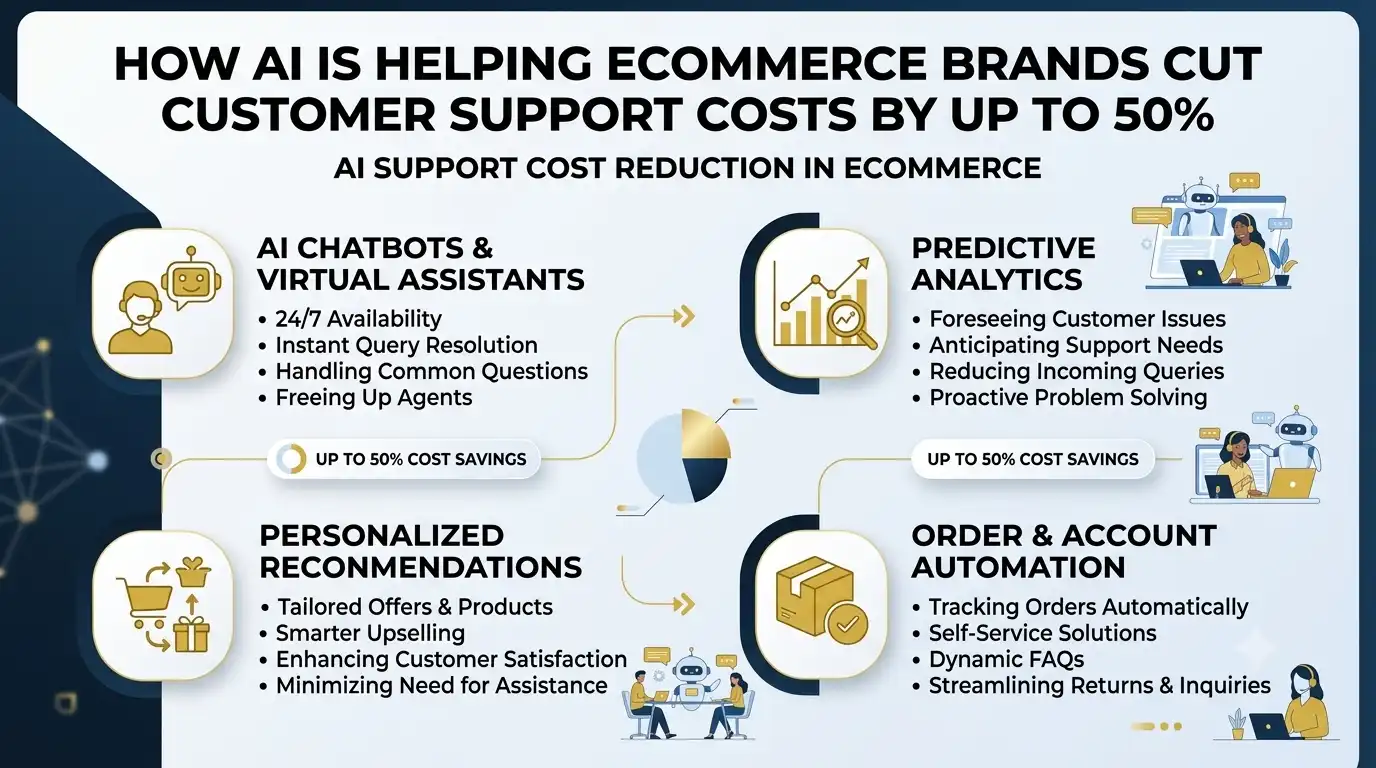
Running a customer support team is expensive. A single live chat interaction costs a business between $6 and $8, and a phone call can run as high as $10 to $14. Multiply that by thousands of monthly inquiries, and support quickly becomes one of the heaviest line items on an ecommerce budget.
Here’s the good news: brands like Alibaba and Klarna have already solved this problem. Alibaba’s AI chatbots now handle 75% of customer queries and save the company roughly $150 million every year. Klarna’s AI assistant does the work of 700 full-time agents. These aren’t small tweaks — they’re complete transformations of how ecommerce support operates. Automate your customer support with Tidio AI.
This article breaks down exactly how AI cuts support costs, which methods deliver the fastest ROI, and how to implement AI support without losing the human touch your customers still expect. Whether you run a small Shopify store or manage support for a growing DTC brand, you’ll walk away with a clear, practical roadmap.
The Real Cost of Traditional Customer Support in Ecommerce
Before AI enters the picture, it helps to understand exactly where the money goes in a traditional support model. Most store owners underestimate these costs because they’re spread across salaries, tools, training, and lost sales — not one single invoice.
Why Manual Support Doesn’t Scale with Order Volume
Traditional support scales in a straight line: more orders mean more tickets, and more tickets mean more agents. There’s no way around it without automation. A store that doubles its sales during a holiday season needs to double its support staff almost overnight, or customers wait longer for answers.
This creates a painful cycle. Businesses either overstaff to prepare for spikes (wasting money during quiet months) or understaff and risk frustrated customers during busy ones. Neither option protects margins.
Hidden Costs: Training, Turnover, and Overtime
Agent salaries are just the visible cost. Every new hire needs onboarding, product training, and time to reach full productivity. Support roles also have high turnover, which means businesses are constantly re-investing in training new staff who may leave within months.
Add overtime pay for nights, weekends, and holidays, and the true cost of “24/7 support” through human agents alone becomes significantly higher than most budgets account for.
The Customer Retention Risk of Slow Support
Speed matters more than most businesses realize. Research from PwC shows that more than half of customers will walk away from a brand after just one poor service experience. In ecommerce, where competitors are one click away, a slow or inconsistent support experience doesn’t just cost a sale — it costs a customer for life.
This is exactly why AI-powered support has moved from “nice to have” to essential infrastructure for ecommerce brands that want to protect both their margins and their reputation.
How AI Reduces Ecommerce Support Costs (Key Methods)
AI doesn’t reduce support costs through one single feature. It works through several connected methods that each remove a piece of manual, repetitive work.
AI Chatbots — Automating Repetitive Queries 24/7
Most customer questions are repetitive: “Where’s my order?”, “What’s your return policy?”, “Do you ship to my country?” AI chatbots resolve up to 91% of these routine queries without any human involvement, and they do it instantly, at any hour.
Because chatbots never sleep, take breaks, or need overtime pay, they deliver true 24/7 coverage at a fraction of what round-the-clock human staffing would cost.
Automated Ticket Routing & Prioritization
When a complex issue does need a human agent, AI still speeds things up. Automated routing systems read the content, urgency, and sentiment of a ticket, then send it straight to the agent best equipped to handle it. This cuts average cost per ticket from around $22 down to $11 — a 50% reduction — while also increasing agent productivity by 20–25%.
Predictive Analytics for Smarter Staffing
Instead of guessing how many agents to schedule, AI analyzes historical ticket data, seasonal trends, and upcoming promotions to forecast demand. This prevents the two costly extremes: overstaffing during slow periods and scrambling to hire during a sales rush.
AI-Powered Self-Service & Knowledge Bases
Modern self-service tools go far beyond a static FAQ page. Using natural language processing, they understand what a customer is actually asking and walk them through a solution step by step — resetting a password, tracking a package, or starting a return — without ever needing to contact an agent.
Multilingual AI Agents for Global Support
Selling internationally traditionally means hiring native speakers for every market you serve. AI agents remove that barrier entirely, handling conversations in 40+ languages and switching between them seamlessly. This is one of the biggest hidden savings for ecommerce brands expanding beyond their home market.
RAG Chatbots — Accurate, Real-Time Answers
Retrieval-Augmented Generation (RAG) chatbots combine generative AI with real-time data lookup. Instead of relying only on pre-trained knowledge, a RAG chatbot can pull a customer’s actual order history or the latest product information before responding. This leads to fewer wrong answers, fewer escalations, and higher first-contact resolution.
AI Case Summaries & Automated Documentation
After every interaction, AI can automatically generate a summary of what happened, the resolution, and the customer’s sentiment. This eliminates manual note-taking, keeps knowledge bases updated in real time, and dramatically shortens the time it takes to train new support hires.
Real Ecommerce Brands Saving Millions with AI Support
Theory is convincing, but real numbers from real companies make the case undeniable.
Alibaba — 75% Queries Automated, $150M Saved Annually
Alibaba’s AI chatbot system handles more than 2 million customer sessions and 10 million messages per day during peak shopping seasons. It resolves 75% of all online questions and 40% of hotline inquiries, saving the company approximately $150 million in support costs every year — while also improving customer satisfaction by 25%.
Klarna — AI Chatbot Equals 700 Full-Time Agents
Klarna’s AI assistant now manages two-thirds of all customer service chats, handling the equivalent workload of 700 full-time agents. Average resolution time dropped from 11 minutes to under 2, and the company reports roughly $40 million in profit improvement as a direct result.
Vodafone’s TOBi — 70% Cost-Per-Chat Reduction
Vodafone’s virtual assistant, TOBi, resolves 70% of customer inquiries independently, cutting cost-per-chat by 70%. Its successor, SuperTOBi, raised first-time resolution rates in Portugal from just 15% to 60%, and lifted Vodafone’s Net Promoter Score by 14 points.
Small-to-Mid Size Brand Example
Enterprise numbers can feel out of reach for smaller stores, but the same math applies at a smaller scale. A mid-sized ecommerce brand handling around 5,000 support tickets a month can realistically automate 60–70% of routine queries (order status, returns, shipping questions) with a basic AI chatbot. At an average savings of $10–15 per ticket deflected from a live agent, that’s $30,000–$50,000 in annual savings — often within the first year of implementation, and without hiring a single additional agent.
Cost Comparison — AI Support vs Traditional Support
Numbers make the case clearer than any explanation can.
Cost Per Ticket: Manual vs AI-Driven
Manual ticket handling averages $22 per ticket once you factor in agent time, categorization, and follow-up. AI-driven ticketing brings that down to roughly $11 — and in high-volume environments, processing costs can drop by up to 85%.
Resolution Time: Hours vs Minutes
Manual resolution can take several hours to a full day depending on ticket backlog. AI-driven support resolves the same tickets in minutes, with first response happening instantly rather than after a queue wait. Tidio’s AI customer support.
Table: AI Chatbot vs Live Agent
| Factor | AI Chatbot | Live Agent |
|---|---|---|
| Cost per interaction | Minimal | High hourly labor cost |
| Availability | 24/7 | Limited to business hours |
| Response time | Near-instant | Minutes to hours |
| Simultaneous conversations | Unlimited | One at a time |
| Complex problem solving | Limited | Strong |
| Consistency | Uniform every time | Varies by agent |
| Scalability during peak season | Instant | Requires hiring |
AI Customer Support Pricing Models Explained
Choosing the right pricing structure matters as much as choosing the right tool. Most AI support platforms now offer one of three models.
Resolution-Based Pricing
You pay only when a ticket is actually resolved by the AI. This works well for stores with unpredictable or complex query types, since you’re never paying for a conversation that didn’t solve the customer’s problem.
Response-Based Pricing
Here, cost is tied to the number of AI-generated replies rather than full resolutions. This model suits high-volume stores that want predictable, granular billing tied directly to usage.
Fixed Subscription vs Usage-Based Pricing
Traditional fixed subscriptions can run $500 to $2,000+ per month regardless of how much support volume you actually use — meaning you often pay for idle capacity during slow months. Usage-based models scale with real demand, so a smaller store isn’t locked into enterprise-level pricing it doesn’t need.
Which Pricing Model Fits Your Store Size
Small and seasonal stores generally benefit most from usage-based or response-based pricing, since costs shrink naturally during slow periods. Larger stores with consistent, high ticket volume may find a fixed or server-based plan more cost-predictable over time.
How to Choose the Right AI Chatbot for Your Ecommerce Store
Not every AI chatbot is built the same way, and the wrong choice can cost you more in lost integrations and poor customer experience than it saves.
Ease of Integration with Your Ecommerce Platform
Your chatbot should connect natively with your platform, whether that’s Shopify, WooCommerce, or a custom-built store, without requiring custom development work just to go live.
Seamless CRM & Helpdesk Integration
Look for a solution that plugs directly into your existing CRM and helpdesk tools. This keeps customer data, order history, and support tickets in one connected system instead of scattered across platforms.
Analytics & Reporting Capabilities
A strong AI chatbot should tell you what’s happening: which queries it resolves, where it hands off to humans, and where customers get stuck. Without this visibility, you can’t improve the system over time.
Scalability for Seasonal Traffic Spikes
Ecommerce traffic isn’t steady. Your AI tool needs to handle a Black Friday surge in ticket volume the same way it handles a quiet Tuesday in February, without any manual reconfiguration.
Personalization & Multilingual Support
The best tools use customer data (past orders, browsing behavior, location) to personalize responses, and support multiple languages if you sell internationally.
Step-by-Step: Implementing AI Support Without Losing the Human Touch
AI works best when it’s introduced deliberately, not dropped in overnight to replace your entire team.
Start with High-Volume, Repetitive Queries First
Begin by automating the questions that come up most often: order tracking, shipping timelines, and return policies. This gives you fast, visible wins without risking your most sensitive customer interactions.
Set Up Smooth Human Handoff for Complex Issues
Build a clear path for the AI to escalate to a human agent the moment a conversation gets complicated or emotional. Customers should never feel trapped in a bot loop when they need real help.
Train Your AI on Store-Specific Data
Feed your chatbot your actual product catalog, return policies, shipping rules, and FAQs. Generic AI training leads to generic, unhelpful answers — specific data leads to accurate ones.
Monitor & Continuously Optimize Bot Performance
Review chatbot conversations regularly. Look for patterns where customers get frustrated or where the bot gives an incorrect answer, then refine its training data accordingly. AI support improves the more it’s used and reviewed.
Future of AI in Ecommerce Customer Support
The technology is still moving quickly, and forward-thinking brands are already preparing for what’s next.
Generative AI for Personalized Responses
Generative AI is enabling chatbots to write more natural, conversational responses instead of relying on rigid scripted replies, making interactions feel less robotic and more human.
Voice Commerce & Voice-Based Support
As voice assistants improve, customers will increasingly expect to resolve support issues by simply speaking, whether that’s checking an order status or requesting a refund through a smart speaker.
Autonomous AI Agents
Industry forecasts suggest that roughly one-third of ecommerce companies will use fully autonomous AI agents by 2028 — systems capable of handling entire support conversations end-to-end, including complex, multi-step requests, without human input.
Frequently Asked Questions
How much can an ecommerce store save using AI chatbots? Most stores that automate routine queries see support cost reductions of 30–50%, with some larger brands like Alibaba saving well over $100 million annually at scale.
Do AI chatbots replace human customer service agents? No. AI chatbots handle repetitive, high-volume queries, while human agents focus on complex or emotionally sensitive issues. The most effective support teams combine both.
What’s the average cost per AI-resolved ticket vs a human-resolved ticket? AI-driven ticket resolution averages around $11, compared to roughly $22 for manual handling — a 50% cost reduction per ticket.
Can small ecommerce stores afford AI chatbots? Yes. Usage-based and response-based pricing models let small stores start with a low monthly cost and scale spending only as their support volume grows.
Which is better — resolution-based or response-based pricing? Resolution-based pricing suits stores with complex or unpredictable queries, since you only pay for solved tickets. Response-based pricing suits high-volume stores that want predictable, per-message billing.
Conclusion — Is AI Worth It for Your Ecommerce Support Team?
The data leaves little room for doubt. AI-powered support cuts cost per ticket in half, resolves routine questions in seconds instead of hours, and scales instantly during your busiest sales periods — all without the overtime, training costs, and turnover that come with a purely human support team.
The brands winning right now aren’t replacing their support teams with AI. They’re using AI to handle the repetitive work so their human agents can focus on the conversations that actually need a person’s judgment. That combination is what protects margins and keeps customers loyal at the same time.
If you’re ready to bring AI-powered support into your store, starting with a chatbot that integrates directly with your platform and existing tools is the fastest way to see results.

Muhammad Safiullah is the AI Agent Development Lead at Rankify SEO & AI Agency, where he builds AI chat agents and automation systems for SaaS and business clients. His work focuses on practical AI implementation that solves real customer support and lead-generation challenges.