
Choosing the wrong SEO partnership model can quietly drain your agency’s profit margin for years. Many agency owners sign up for the first “white label SEO” deal they find, only to realize six months later that they picked the wrong structure for their business. The result? Confused clients, thin margins, and a brand that never truly feels like their own.
This guide breaks down the three models agencies actually use to scale SEO services without hiring a full in-house team: white label SEO, private label SEO, and reseller SEO. By the end, you will know exactly which model fits your agency, your budget, and your growth stage.
What Is White Label SEO?
White label SEO is a partnership where a specialized SEO provider does the actual optimization work, and your agency sells that work to clients under your own brand name. The client never sees the provider’s name anywhere. They only see your agency’s logo, your reports, and your point of contact.
Think of it like a private manufacturer that builds a product, then lets different retailers sell it under their own packaging. The provider handles keyword research, link building, technical audits, and content optimization. Your team handles client communication, sales, and account management.
How White Label SEO Works
The workflow usually follows four steps. First, you sign a contract with a white label SEO agency. Second, you send them your client’s website details and goals. Third, the provider executes the SEO strategy behind the scenes. Fourth, you repackage their reports with your branding and send them to your client.
Most white label providers offer flexible packages: link building only, full-service SEO, local SEO, or technical audits. This flexibility lets small agencies offer enterprise-level services without hiring specialists.
Pros and Cons of White Label SEO
White label SEO lets you scale fast without payroll risk. You can take on ten new clients this month and simply route the work to your provider, instead of scrambling to hire and train SEO analysts. It also reduces delivery risk, since you are working with an established team that already has proven processes.
However, white label SEO comes with a real dependency problem. Your service quality is only as good as your provider’s. If they miss a deadline or produce weak content, your agency’s reputation takes the hit, not theirs. Margins can also shrink if you are reselling at a low markup, since you still pay the provider’s rate on every project.
What Is Private Label SEO?
Private label SEO takes the white label concept one step further. Instead of just rebranding a generic service, you get a fully customized, exclusive process built around your agency’s specific methodology, tools, and client type.
Private label providers often let you shape the strategy, reporting templates, and even the software dashboard your clients log into. It feels less like renting someone else’s service and more like building your own SEO department, minus the overhead of full-time salaries.
How Private Label SEO Works
A private label relationship usually starts with a deeper onboarding process. The provider studies your client base, your typical project scope, and your brand voice. From there, they build custom SOPs (standard operating procedures) that match how your agency wants SEO delivered, not a one-size-fits-all package.
This model often includes dedicated account managers who only work with your agency, custom-branded dashboards, and reporting that mirrors your exact style guide. Some agencies even get exclusive access to certain tools or link inventories that other clients of the provider cannot touch.
Pros and Cons of Private Label SEO
The biggest advantage is control. Your agency’s methodology stays consistent across every client, which builds a stronger, more defensible brand identity. Clients also get a more tailored experience, since the strategy is not a copy-paste template used across dozens of other agencies.
The tradeoff is cost and commitment. Private label SEO usually requires higher monthly minimums or longer contracts, since the provider is investing real time into customizing their process for you. It also takes longer to launch, since building custom SOPs and dashboards is not an overnight task.
What Is Reseller SEO?
Reseller SEO is the simplest and most transactional of the three models. You act purely as a middleman: you sell an SEO package, pass the client’s information to the provider, and the provider delivers the service, sometimes even communicating directly with the client under a shared or neutral brand.
Unlike white label SEO, reseller arrangements do not always hide the provider’s involvement completely. Some reseller programs are transparent about who does the actual work, especially in business-to-business contexts where the end client only cares about results, not who is behind the curtain.
How Reseller SEO Works
Reseller SEO typically runs on a commission or margin-based model. You find the client, negotiate the price, and take a percentage or flat markup for the referral. The provider then either works directly with the client or feeds updates back to you to relay.
This model is common among freelancers, consultants, and small agencies who are strong at sales and client relationships but do not want to manage delivery at all. It requires the least operational setup of the three models.
Pros and Cons of Reseller SEO
Reseller SEO has the lowest barrier to entry. You do not need SEO expertise, project management systems, or a delivery team. You simply need to find clients and negotiate good terms with a reliable provider.
The downside is limited brand control. Since the provider may interact with the client directly, your agency’s identity can get diluted or bypassed entirely over time. Margins also tend to be thinner, since resellers usually earn less per project than agencies that manage the full white label or private label relationship.
White Label vs Private Label vs Reseller SEO: Key Differences
| Factor | White Label SEO | Private Label SEO | Reseller SEO |
| Branding | Fully your brand | Fully your brand, customized process | Often shared or provider-visible |
| Customization | Standard packages | Highly customized SOPs | Minimal, mostly pre-set |
| Client contact | Your agency only | Your agency only | May involve the provider directly |
| Setup time | Fast (days to weeks) | Slower (weeks to months) | Fastest (days) |
| Cost structure | Fixed provider rate + your markup | Higher minimums, custom pricing | Commission or margin split |
| Best for | Growing agencies wanting to scale delivery | Established agencies wanting a defensible brand | Freelancers and referral-based sellers |
| Control over strategy | Moderate | High | Low |
| Risk exposure | Moderate (provider quality risk) | Lower (dedicated team, tighter QA) | Higher (less oversight of delivery) |
Which Model Should You Choose?
The right model depends less on which one sounds more “premium” and more on your agency’s current stage, team size, and sales capacity.
For Agencies
If you already have a client base and want to expand your service menu without hiring specialists, white label SEO is usually the fastest path. It lets you say yes to more clients this quarter without a hiring cycle. If your agency has matured past the ten-to-twenty client mark and wants a truly distinct brand identity, private label SEO becomes worth the higher investment.
For Freelancers
Solo consultants and freelancers who are strong closers but have no delivery team should start with reseller SEO. It removes the operational burden entirely and lets you focus on what you do best: finding and closing clients.
For Businesses Buying SEO Services
If you are a business owner buying SEO rather than reselling it, this comparison still matters. Ask any agency you are considering whether they use white label, private label, or reseller arrangements. Agencies using private label partnerships or fully in-house teams typically offer more consistent quality and accountability than those reselling with little oversight.
Pricing Comparison
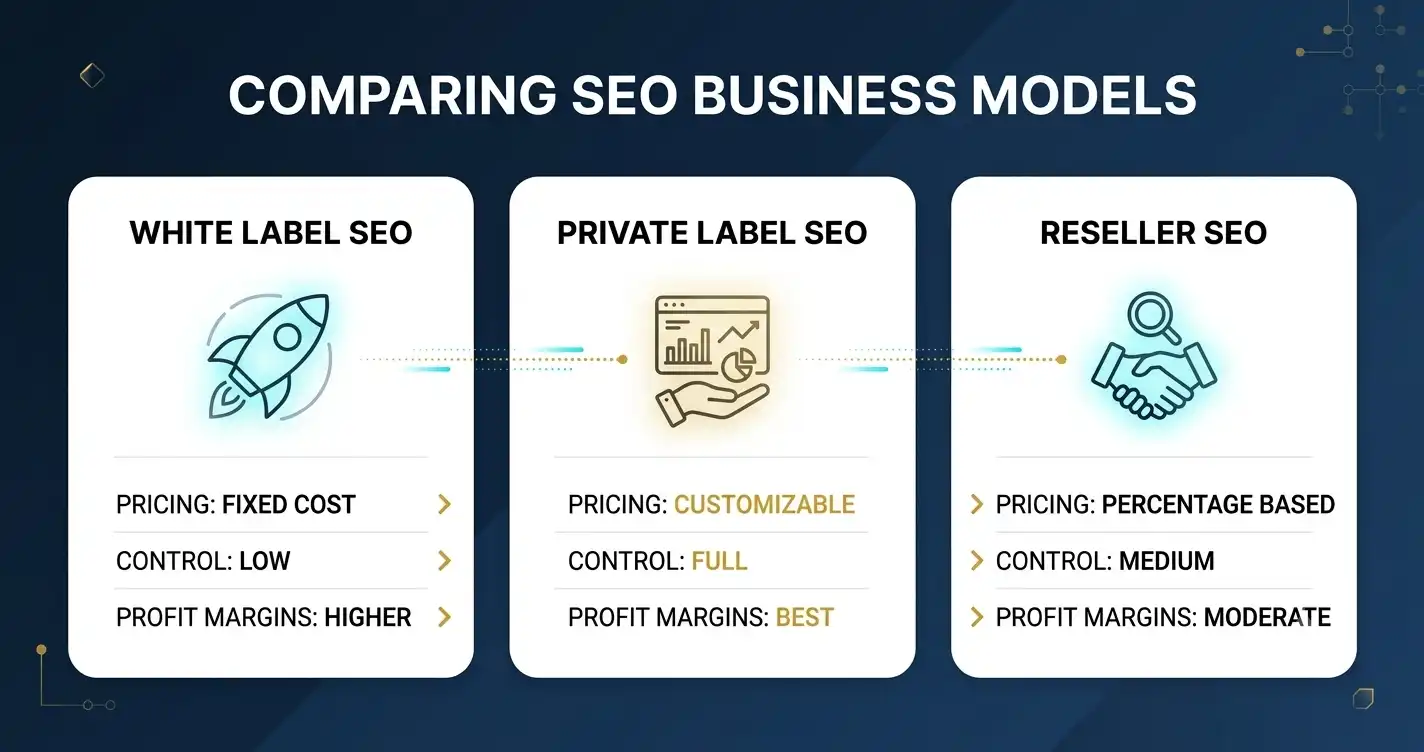
Pricing varies widely across the industry, but a general pattern holds true across most providers. White label SEO packages tend to sit in the mid-range, since providers price for volume and repeat business from multiple agencies. Private label SEO commands a premium, often requiring higher monthly minimums, because of the custom onboarding and dedicated resources involved. Reseller SEO margins are usually the thinnest per project, since the reseller’s value-add is limited to sales and relationship management rather than delivery.
Before signing any contract, always request a sample report, a client-facing dashboard demo, and a clear breakdown of what happens if a deliverable is missed or delayed.
Common Mistakes to Avoid
Many agency owners rush into a white label or reseller partnership without checking the provider’s actual track record. Always ask for real client results, not just generic case studies. Another common mistake is failing to clarify communication boundaries, especially in reseller arrangements where the provider may end up speaking to your client without your knowledge.
Agencies also frequently underprice their services when reselling, leaving almost no margin after the provider’s cut. Build your pricing around the value delivered to the client, not just the provider’s base rate plus a small markup.
Finally, do not assume every white label or private label provider follows current Google guidelines. Verify their approach to link building, content quality, and technical SEO before committing, since outdated tactics can get your client’s site penalized.
Frequently Asked Questions
Is white label SEO legal and ethical? Yes. White label SEO is a standard, widely used business model across the digital marketing industry. It is fully legal and ethical as long as the agency is transparent with its own client about the quality and scope of the service being delivered, even if the specific vendor relationship stays private.
Which model has the highest profit margin? Private label SEO usually offers the strongest long-term margins because of stronger client retention and brand loyalty, even though the upfront investment is higher. White label SEO offers solid mid-range margins with faster setup. Reseller SEO typically has the lowest margin per project.
Can I switch from reseller SEO to white label SEO later? Yes. Many agencies start with reseller arrangements to test the market with low risk, then transition to white label SEO once they have steady client volume and want more control over branding and delivery.
Do clients ever find out about white label or reseller arrangements? It happens occasionally, usually through indirect discovery rather than disclosure. This is why choosing a reliable provider with strict confidentiality practices matters, especially for agencies built entirely on white label delivery.
What is the minimum agency size needed for private label SEO? There is no fixed number, but most private label providers look for agencies with consistent monthly client volume, since the setup and customization work only makes financial sense at scale.
Conclusion
White label SEO, private label SEO, and reseller SEO all solve the same core problem: how to deliver expert SEO services without building an entire in-house department. The difference lies in how much control, customization, and brand ownership your agency needs at its current stage.
Start with reseller SEO if you are testing the market with minimal risk. Move to white label SEO once you have steady client flow and want full branding control. Graduate to private label SEO once your agency is ready to invest in a truly custom, defensible service built entirely around your brand.
Whichever model you choose, the goal stays the same: consistent rankings, happy clients, and a business model that scales without breaking your delivery quality.

Asrar Ahmad is the founder and lead SEO strategist at Rankify SEO & AI Agency, with 4+ years of experience in technical, on-page, and off-page SEO for US and UK clients. He specializes in topical authority building, keyword strategy, and data-driven content that ranks and converts.