
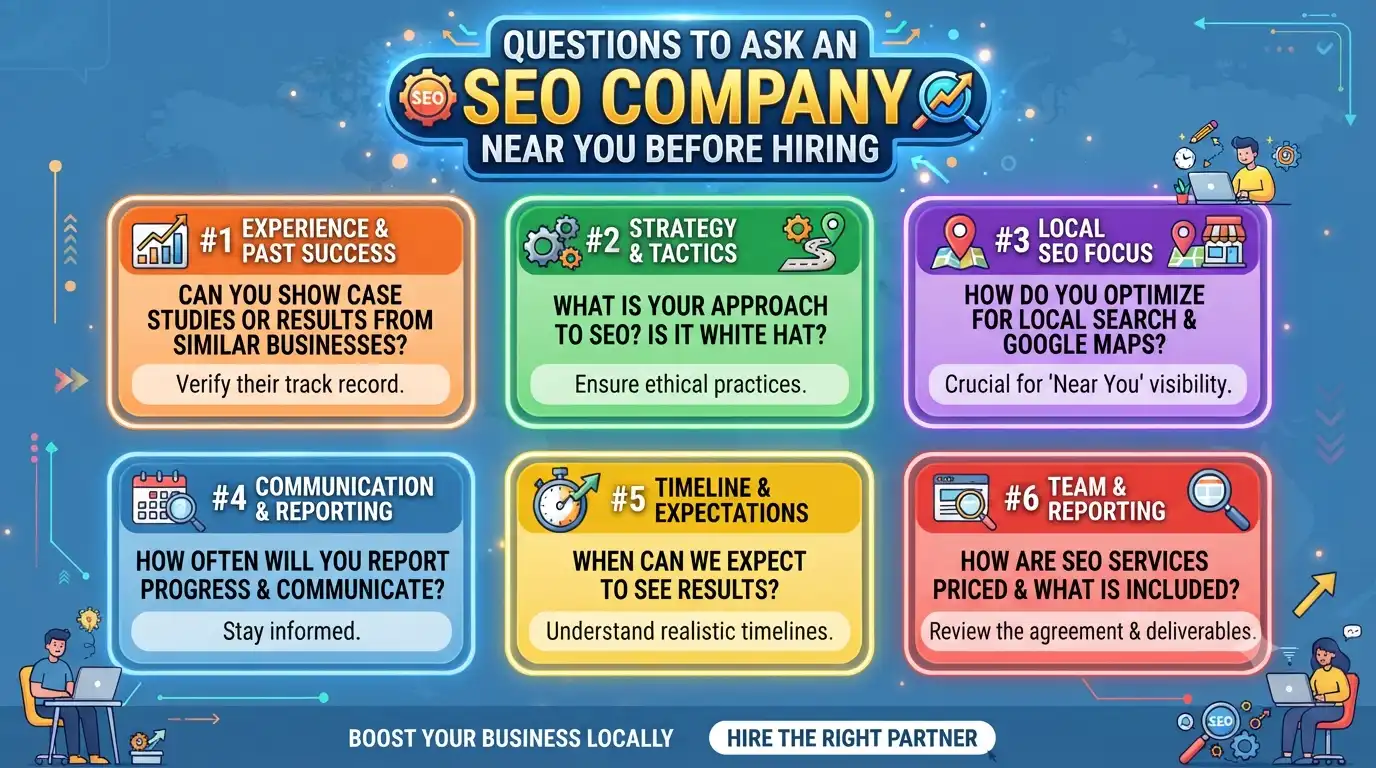
Finding the right local SEO partner can transform your business, driving targeted local traffic, phone calls, and revenue growth. However, hiring the wrong agency often results in wasted marketing budgets, unfulfilled promises, and potential search engine penalties.
Many businesses rush into contracts based on flashy promises and cheap pricing without understanding how search engine optimization actually works. To make a confident decision, you must evaluate candidate agencies using structured criteria, modern technical standards, and full operational transparency.
This comprehensive guide outlines the critical questions to ask an SEO company near you before hiring, covering fundamental SEO models, technical evaluation, fulfillment strategies, and agency accountability.
Why Vetting a Local SEO Agency Matters More Than Ever
Search engine optimization is no longer limited to basic keyword density and simple link building. Search engines prioritize user intent, topical authority, semantic context, and real-world credibility—collectively captured under frameworks like Google’s E-E-A-T (Experience, Expertise, Authoritativeness, and Trustworthiness) guidelines.
                     ┌─────────────────────────────────────────┐
                     │   Evaluating a Local SEO Partner        │
                     └────────────────────┬────────────────────┘
                                          │
         ┌────────────────────────────────┼────────────────────────────────┐
         ▼                                ▼                                ▼
┌─────────────────┐              ┌─────────────────┐              ┌─────────────────┐
│ Strategy & EEAT │              │ Technical & Fulfillment │        │ Transparency    │
│ • Intent focus  │              │ • Audits & Code         │        │ • Reporting     │
│ • Local signals │              │ • White Label Execution │        │ • Direct access │
└─────────────────┘              └─────────────────┘              └─────────────────┘
When hiring a local provider, you are entrusting them with your core digital footprint. Evaluating agencies with targeted, in-depth questions helps ensure that:
- Your site avoids black-hat penalties that permanently suppress organic visibility.
- Your budget aligns with clear outcomes rather than vague vanity metrics like raw impressions.
- Your local listings (Google Business Profile) remain consistent across directories.
- The agency understands semantic search, entity mapping, and intent-based content creation.
Key Questions About Strategy, Process, and E-E-A-T
1. How Do You Define and Measure SEO Success for Our Specific Industry?
A qualified agency measures success using business-level metrics rather than superficial metrics alone. While rank position matters, business growth relies on qualified conversions, phone calls, form submissions, and organic revenue.
- Green Flags: They ask about your customer lifetime value (LTV), target profit margins, and primary sales funnel before promising specific outcomes.
- Red Flags: Guaranteed #1 positions on Google within 30 days. No legitimate agency controls search algorithms.
2. How Do You Approach Google’s E-E-A-T and Semantic Search Alignment?
Modern search engines evaluate content based on real-world expert validation and topical depth. Ask candidate agencies how they incorporate author background, original industry research, structured schema markup, and entity relationship mapping into their strategy.
3. Do You Have Case Studies or References from Similar Local Businesses?
Request documented case studies that highlight baseline performance, tactical execution, and final quantifiable results.
Important: Ensure the agency explains how they solved a problem—such as recovering from a technical drop or scaling local map-pack rankings—rather than merely showing traffic screenshots without context.
Core Operational Models: How White Label SEO Agencies Operate
Many local digital marketing agencies, web design firms, and IT providers do not complete every technical task in-house. Instead, they partner with specialized fulfillment vendors using white-label structures. Understanding how this process functions helps clarify who handles your site’s strategy and execution.
How Does White Label SEO Work?
White label SEO is an operational partnership where one company (such as a local web design firm or digital agency) sells SEO services to its clients under its own brand name, while a specialized third-party partner handles the actual technical optimization, content creation, and link building behind the scenes.
┌─────────────────┐       Sells Service       ┌────────────────────────┐
│  End Client     │ ◄───────────────────────► │  Local Agency / Firm   │
└─────────────────┘                           └───────────┬────────────┘
                                                          │
                                     Fulfills Work        │ (Re-branded)
                                     Behind the Scenes    │
                                                          ▼
                                              ┌────────────────────────┐
                                              │ White Label Partner    │
                                              └────────────────────────┘
The client receives reports, dashboards, and communication bearing the local agency’s logo, while benefiting from the specialized infrastructure of an established fulfillment provider.
Understanding Agency Structure Options
| Agency Type | Execution Model | Ideal For | Key Advantage |
| Fully In-House Agency | All strategists, writers, and coders are direct employees. | Mid-to-large businesses needing highly customized solutions. | Direct communication with every specialist working on the account. |
| Hybrid Local Agency | In-house strategy and client management combined with external fulfillment. | Small-to-medium businesses wanting local contacts and scalable delivery. | Local accountability backed by broad operational scale. |
| White Label Fulfillment Partner | Executes specialized deliverables on behalf of partner agencies. | Agencies expanding service offerings without adding internal headcount. | Access to dedicated tooling, specialized teams, and proven processes. |
Advanced Execution Strategies: Fulfillment, Technicals, and Audits
When reviewing candidate agencies, evaluate their technical methods, audit practices, and fulfillment mechanisms.
                     ┌─────────────────────────────────────────┐
                     │    Key Pillars of Agency Fulfillment    │
                     └────────────────────┬────────────────────┘
                                          │
         ┌────────────────────────────────┼────────────────────────────────┐
         ▼                                ▼                                ▼
┌─────────────────┐              ┌─────────────────┐              ┌─────────────────┐
│ Technical Audits│              │ Content Strategy│              │ Reporting Systems│
│ • Architecture  │              │ • Intent & E-E-A-T│              │ • Live Data     │
│ • Schema & Code │              │ • Topical Clusters│            │ • Transparent   │
└─────────────────┘              └─────────────────┘              └─────────────────┘
White Label Technical SEO Audit Services
A reliable agency bases its initial recommendations on a comprehensive technical evaluation rather than basic automated scripts. High-quality white label technical SEO audit services review core underlying factors, including:
- Crawl depth, indexation limits, and rendering budgets.
- Site architecture, internal link distribution, and canonical tag structure.
- Page Speed Insights, Core Web Vitals, and mobile usability.
- Structured Data (JSON-LD schema for LocalBusiness, Service, and FAQPage).
White Label Content Writing + SEO Integration
Content creation requires aligning search intent with topical context. Effective white label content writing + SEO strategies avoid fluff and focus on structured, value-driven execution:
- Keyword Clustering: Grouping semantically related search terms onto a single authoritative page rather than creating thin, duplicate pages.
- Intent Alignment: Matching content depth and format (informational, commercial, transactional, or navigational) to user expectations.
- On-Page Optimization: Writing clear primary headers (H1), structured section titles (H2, H3), descriptive image alt tags, and engaging meta tags.
White Label SEO Dashboard Software for Client Reporting
Transparent reporting maintains accountability throughout an SEO campaign. Leading agencies leverage modern white label SEO dashboard software (such as Google Looker Studio, AgencyAnalytics, or proprietary tracking portals) to provide real-time performance visibility.
Essential dashboard metrics to look for include:
- Organic traffic trends segmented by non-branded search terms.
- Conversions, form submissions, and trackable call events.
- Local Google Map Pack positions across distinct grid points.
- Crawl health statuses, active indexation metrics, and technical resolution logs.
Evaluating Scale and Agency Types
White Label SEO for Small Agencies
For smaller marketing boutiques, leveraging white label SEO for small agencies provides access to specialized tools, dedicated technical analysts, and scalable content production without the overhead of hiring full-time, in-house technical teams.
White Label SEO for Web Design Agencies
Development and web design firms frequently deploy white label SEO for web design agencies to deliver search-optimized site builds from launch day, ensuring that clean code, proper redirects, logical site architecture, and local schema are integrated seamlessly.
Examining a White Label SEO White Paper / Case Study
Before finalizing a partner contract, ask candidate agencies to share a white label SEO white paper / case study. Analyzing these documents helps evaluate:
- Data-backed methodology over generic claims.
- Baseline comparison metrics and timeline progression.
- Documented recovery strategies following core search algorithm updates.
Essential Checklist: 15 Questions to Ask Before Signing a Contract
Print or save this structured checklist for agency discovery meetings:
┌─────────────────────────────────────────────────────────────────────────┐
│                  AGENCY EVALUATION CHECKLIST                            │
├─────────────────────────────────────────────────────────────────────────┤
│  [ ] 1. Who will handle day-to-day execution on our account?            │
│  [ ] 2. What specific deliverables are included in our monthly plan?    │
│  [ ] 3. How do you assess technical health and Core Web Vitals?        │
│  [ ] 4. What is your link building strategy and safety protocol?        │
│  [ ] 5. How do you optimize Google Business Profiles for local search? │
│  [ ] 6. Will we retain full ownership of our analytics and assets?      │
│  [ ] 7. How do you adjust strategies when performance stalls?           │
│  [ ] 8. What is the contract length, exit policy, and notice period?    │
└─────────────────────────────────────────────────────────────────────────┘
- Who will handle day-to-day work on our account? Ask whether tasks are managed by dedicated in-house staff or an external fulfillment team.
- How do you perform initial baseline technical audits? Confirm whether audits rely solely on automated tool exports or include manual analysis.
- What specific deliverables are included in the monthly retainer? Request a detailed breakdown of technical fixes, content creation, and link acquisition.
- How do you handle Google Business Profile optimization and local citations? Verify their process for audit accuracy, NAP (Name, Address, Phone) consistency, and review acquisition strategies.
- What is your backlink strategy, and how do you ensure safety? Ensure they acquire contextually relevant, earned links rather than low-quality automated placements.
- How do you stay aligned with Google’s Core Updates and E-E-A-T guidelines? Confirm that their practices prioritize helpful content and technical quality.
- Will we retain full ownership of our digital assets, analytics, and accounts? Ensure you retain master access to Google Search Console, Google Analytics, Tag Manager, and domain setups.
- What reporting tools and dashboard software do you provide? Check if you receive live access to transparent performance dashboards.
- How do you prevent keyword cannibalization and maintain topical structure? Confirm how site maps and content hubs are organized.
- Do you currently work with direct local competitors in our niche? Clarify exclusivity terms and conflict-of-interest policies.
- What is the minimum contract length, and what are the cancellation terms? Review retainer commitments, exit clauses, and transition procedures.
- How frequently will we hold strategic review calls? Establish a consistent communication schedule for performance updates.
- What specific requirements do you need from our internal team to launch? Identify initial resource dependencies, such as access credentials and branding guidelines.
- How do you handle local schema markup and semantic entities? Verify their capabilities in deploying structured data.
- Can you show a white label case study demonstrating long-term performance growth? Review verified data showing historical performance stability across search updates.
Frequently Asked Questions (FAQs)
How long does it usually take to see measurable SEO results?
SEO is a long-term compound growth strategy. While technical improvements and indexing updates can yield early wins within 30 to 60 days, significant ranking improvements, traffic growth, and lead increases typically occur within 4 to 6 months of continuous optimization.
What is the average cost of hiring a local SEO company?
Local SEO retainers generally range between $750 and $3,500 per month, depending on competitive intensity, market size, technical site complexity, and project scope. Be cautious of providers offering “complete SEO” for under $300 per month, as these packages often rely on automated spam techniques that risk algorithmic penalties.
Should I hire a local agency near me or a specialized remote agency?
A nearby local agency often understands your local market dynamics, regional geography, and community trends effectively. However, a specialized remote agency with deep experience in your specific industry can be equally effective. Choose based on strategic capability, communication clarity, and execution quality rather than physical proximity alone.
Conclusion: Making the Right Hiring Decision
Hiring an SEO company near you is an investment in your business’s long-term digital growth. By asking targeted questions about technical expertise, strategic processes, fulfillment structures, and client transparency, you can distinguish high-performing partners from unreliable providers.
Evaluate candidate agencies on their commitment to search intent alignment, structured data standards, clear reporting, and Google E-E-A-T guidelines. A qualified SEO partner will welcome detailed vetting questions, explain their methodology clearly, and work collaboratively to turn organic search into a reliable revenue driver.

Asrar Ahmad is the founder and lead SEO strategist at Rankify SEO & AI Agency, with 4+ years of experience in technical, on-page, and off-page SEO for US and UK clients. He specializes in topical authority building, keyword strategy, and data-driven content that ranks and converts.