If you run a Shopify or WooCommerce store, there’s a good chance to add AI to Zendesk without migrating. You’ve looked into AI customer support tools before and quietly closed the tab. Not because the idea wasn’t appealing, but because it sounded like a project — a full migration, weeks of setup, and retraining your team on a whole new system while your current one, imperfect as it is, keeps the lights on.
Here’s the part most store owners miss: you don’t need to migrate away from Zendesk, Intercom, or Gorgias to get AI-powered customer support. You can add AI to Zendesk without migrating anything, and this guide walks through exactly how that works.
If you’d rather skip ahead and see it for yourself, you can try Tidio’s Lyro AI here — otherwise, here’s the full breakdown.
The Assumption That Stops Most Store Owners From Trying AI Customer Support
When people hear “AI customer support,” they picture an all-or-nothing switch — ripping out their existing helpdesk and rebuilding their entire support workflow around a new platform. That assumption alone is enough to make most business owners shelve the idea indefinitely. Nobody wants to touch a system that’s currently working, even if it’s not working well.
But that’s not how modern AI support tools like Tidio’s Lyro AI actually function. The entire premise is built around helpdesk integration, not helpdesk replacement.
The Real Model: Add an AI Layer, Don’t Replace Your Foundation
Lyro AI is designed to sit on top of the helpdesk you already have. If you’re running Zendesk, it works with Zendesk. If you’re on Intercom or Gorgias, it integrates with those too. There’s no need to export your ticket history, retrain your agents on new software, or change how your team logs in every morning.
In practice, adding this AI layer means:
- Your existing helpdesk stays exactly where it is — no data migration, no re-platforming.
- Your support agents keep using the tools they already know how to operate.
- The AI layer handles repetitive, high-volume customer service questions automatically — things like “Where is my order?”, “What’s your return policy?”, or “Do you ship internationally?”
- Anything that needs human judgment still reaches your team, just with far less noise surrounding it.
Instead of a migration project, adding AI to your customer support becomes a simple addition. You’re not tearing anything down. You’re giving your existing helpdesk a layer that absorbs the repetitive workload your team shouldn’t have to handle manually.
Why the “Add, Don’t Migrate” Approach Actually Matters
This isn’t just a marketing angle — it changes the entire cost-benefit calculation for a store owner evaluating AI customer support software.
A full platform migration carries real operational risk: downtime, data loss, a steep learning curve for your support team, and weeks where service quality might actually dip before it improves. That risk alone is often enough to keep growing ecommerce brands stuck with a helpdesk they’ve outgrown.
Choosing to add an AI layer instead removes almost all of that risk. There’s no rip-and-replace moment. If the AI layer doesn’t perform the way you expect, you haven’t restructured your entire customer support operation to find that out — you’ve simply added a tool that either earns its place in your workflow or doesn’t.
A Real Example: How Borrowell Added AI to Zendesk Without Migrating
Numbers are more convincing than theory, so here’s a real case study.
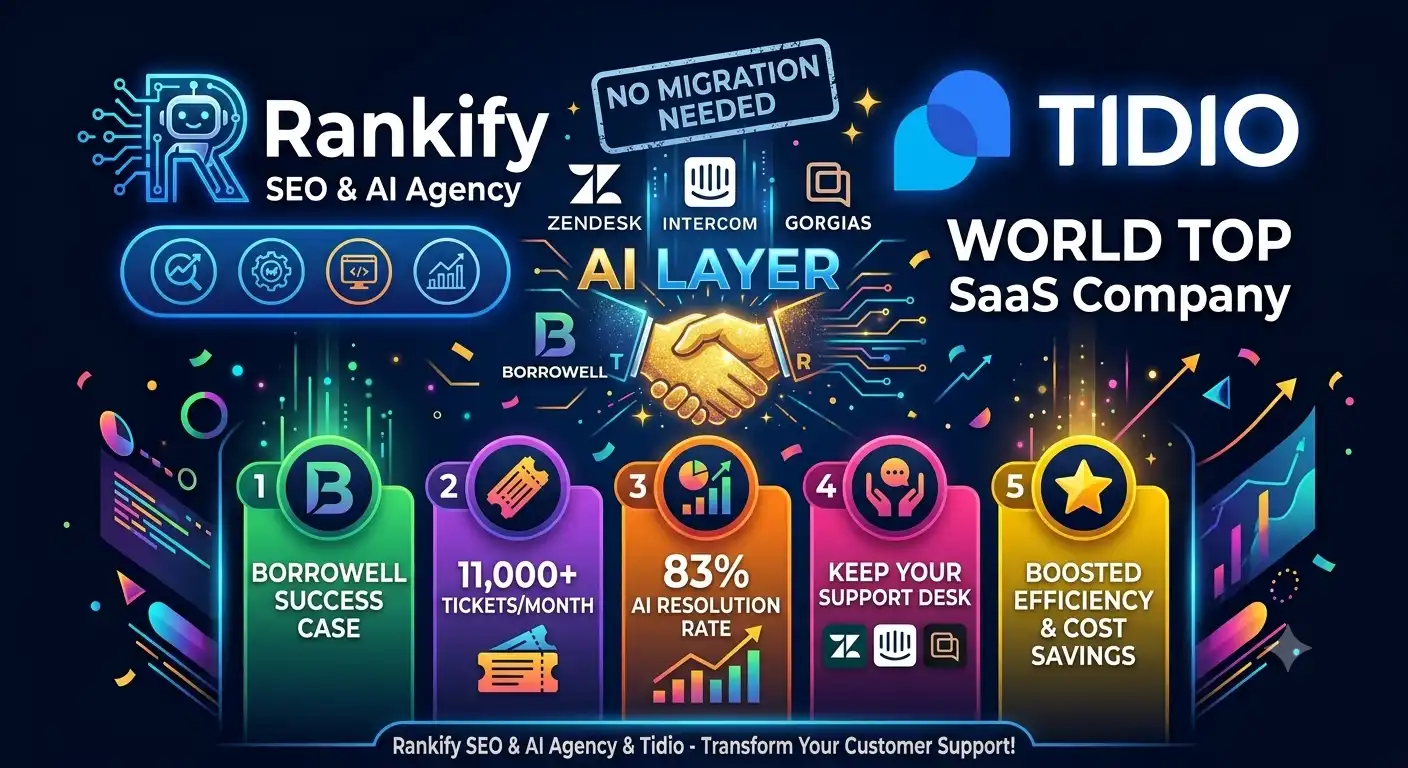
Borrowell layered Tidio’s Lyro AI on top of their existing Zendesk setup — no migration, no rebuild, no re-platforming. The results speak for themselves:
- 83% resolution rate on incoming customer support queries
- 11,000+ support tickets handled per month
- All managed by a support team of just 9 people
For context, a support team handling that ticket volume without AI assistance would typically need to be significantly larger, or accept slower response times and a growing backlog. Borrowell got neither outcome. They kept their existing Zendesk workflow completely intact and simply added an AI layer that absorbed the bulk of repetitive requests.
This is the kind of result that’s hard to argue with, because it didn’t require Borrowell to change anything about their existing customer support stack — only to add to it.
What Kind of Support Questions Does an AI Layer Actually Handle?
For ecommerce and DTC brands specifically, a large share of support ticket volume tends to fall into a few repeatable, automatable categories.
WISMO Queries (“Where Is My Order?”)
This is often the single largest category of ecommerce support tickets. An AI layer can pull order status directly from your systems and respond instantly, without a human agent needing to manually look anything up.
Shipping and Delivery Questions
“Do you ship to Canada?” “How long does delivery take?” These are static, predictable answers that don’t need a live agent to repeat every single time they’re asked.
Returns and Refunds
Basic return policy questions and refund status checks are prime candidates for automation, freeing your support team to handle the more nuanced cases — like disputes or damaged items — personally and with proper attention.
Product Availability and Restocks
“Is this back in stock?” is another common, repetitive question that AI-powered support can field instantly, often improving the customer experience simply by responding faster than a human could during busy periods.
Cost Comparison: Why an AI Layer Is Also the More Affordable Path
Beyond the setup simplicity, there’s a financial case for this approach too. Tidio’s Lyro AI costs roughly $0.50 per resolved conversation, compared to $0.99 for Intercom Fin and $1.00–$2.00 for Zendesk’s own native AI tools. Since you’re not paying for a full platform switch, and you’re only adding an AI layer to handle high-volume repetitive queries, the cost efficiency compounds quickly for stores handling thousands of monthly conversations.
Common Objections, Answered Honestly
Even with a low-risk setup, it’s normal to have reservations before adding any new tool to your customer support stack. Here are the objections we hear most often — and honest answers to each.
“Won’t an AI layer make my support feel less personal?”
This is a fair concern, and the honest answer is: it depends on how you configure it. The goal isn’t to have AI handle every conversation — it’s to have the AI layer absorb the repetitive, low-nuance questions so your human agents have more time and attention for conversations that genuinely benefit from a personal touch. In Borrowell’s case, an 83% resolution rate didn’t mean customers never spoke to a human when they needed to — it meant the team could focus their energy where it actually mattered.
“What if the AI gives a wrong answer?”
Like any automation, it’s worth starting narrow. Most teams begin by letting the AI layer handle only the highest-confidence, lowest-risk categories — shipping timelines, order status, return policy basics — and expand into more complex categories only once they’ve seen consistent accuracy. Escalation to a human agent remains available at every step, so an uncertain answer isn’t a dead end for the customer.
“Is integrating AI into my existing helpdesk going to be a headache?”
Compared to a full helpdesk migration, no. Since the AI layer connects to your existing helpdesk rather than replacing it, there’s no data export, no retraining your whole team on a new interface, and no downtime while you transition. Most of the setup work is simply defining which categories of support questions the AI should handle first.
“What if my team already tried a chatbot and it felt gimmicky?”
This is common, and usually the issue was a chatbot operating as a disconnected widget rather than something integrated into the actual support workflow. The difference with a properly layered AI approach is that it works inside your existing ticketing system, so escalations and handoffs happen naturally instead of customers being bounced between a chatbot and a separate support inbox.
Who Should Consider Adding an AI Layer to Their Helpdesk?
This “add AI, don’t migrate” model tends to make the most sense for:
- Growing ecommerce and DTC brands with a support team of roughly 5–15 agents who are starting to feel ticket volume outpace their headcount.
- Store owners who are otherwise happy with their current helpdesk and have no appetite for a full platform switch.
- Teams drowning in repetitive customer service questions that don’t require judgment or nuance — the kind of tickets that eat hours but add little value when handled manually.
If your support backlog is growing and your instinct has been “we’d need to overhaul everything to fix this,” that instinct is worth reconsidering.
How to Get Started Adding AI to Your Helpdesk
The process is intentionally lightweight. You connect the AI layer to your existing helpdesk, configure it on the categories of support questions you want it to handle first — usually starting with WISMO and shipping queries, since they’re the highest volume and lowest risk — and expand from there as you see results.
There’s no need to commit to a full rollout on day one. Most teams start narrow, automating just the most repetitive 20% of tickets, and expand once they see the resolution rate and cost savings for themselves.
Calculate Your Own Potential Savings
Every store’s numbers look different depending on team size and monthly ticket volume. Rather than relying on averages like Borrowell’s, it’s worth calculating your own using Tidio’s free ROI calculator, which estimates savings based on your actual customer support volume.
For a support team of around 10 agents, projected first-year savings from adding an AI layer to an existing helpdesk often come in above $300,000 — a number worth checking against your own numbers before writing off the idea.
Frequently Asked Questions
Do I need to migrate away from Zendesk, Intercom, or Gorgias to add AI support?
No. Tidio’s Lyro AI is built specifically to work on top of your existing helpdesk rather than replace it, so you can add AI to Zendesk without migrating any data or workflows.
What kind of results can I expect from adding an AI layer?
Results vary by store, but Borrowell — using Lyro AI on top of their existing Zendesk setup — achieved an 83% resolution rate while handling over 11,000 tickets a month with a 9-person support team.
What types of support questions does an AI layer handle best?
High-volume, repetitive customer service questions such as order status (WISMO), shipping timelines, return policies, and product availability tend to be the best starting point for automation.
Is adding an AI layer more affordable than switching to a fully AI-native helpdesk?
Generally, yes. Since you’re adding a layer rather than replacing your entire platform, there’s no migration cost, and Lyro AI’s per-conversation pricing (around $0.50) is lower than comparable AI tools built into Zendesk and Intercom.
Ready to see what an AI layer could do for your existing helpdesk? Get started with Tidio here and see how much of your ticket backlog could be handled automatically, without touching the customer support system you already rely on.
Have questions about adding AI to your existing customer support stack? Get in touch with Rankify SEO & AI Agency — we’re happy to help you figure out the right

Muhammad Safiullah is the AI Agent Development Lead at Rankify SEO & AI Agency, where he builds AI chat agents and automation systems for SaaS and business clients. His work focuses on practical AI implementation that solves real customer support and lead-generation challenges.